
Watch the video version
Three parts in eight minutes: what Sudoku is, the story of the first row told by hand, and the code built piece by piece. The written version below keeps the whole program in one place and lets you run it.
Watch on YouTube1 · The problemThe puzzle and its three rules
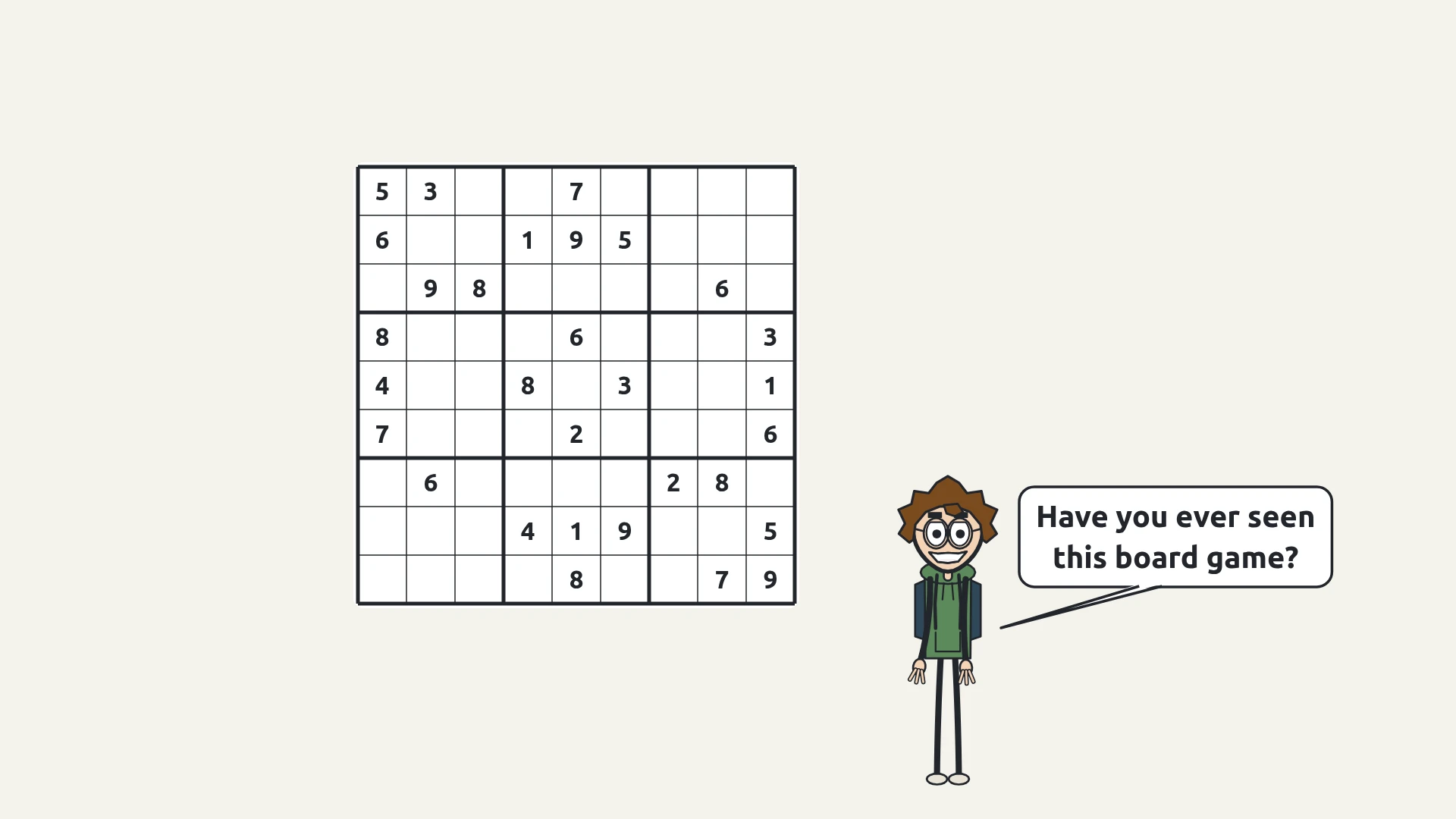
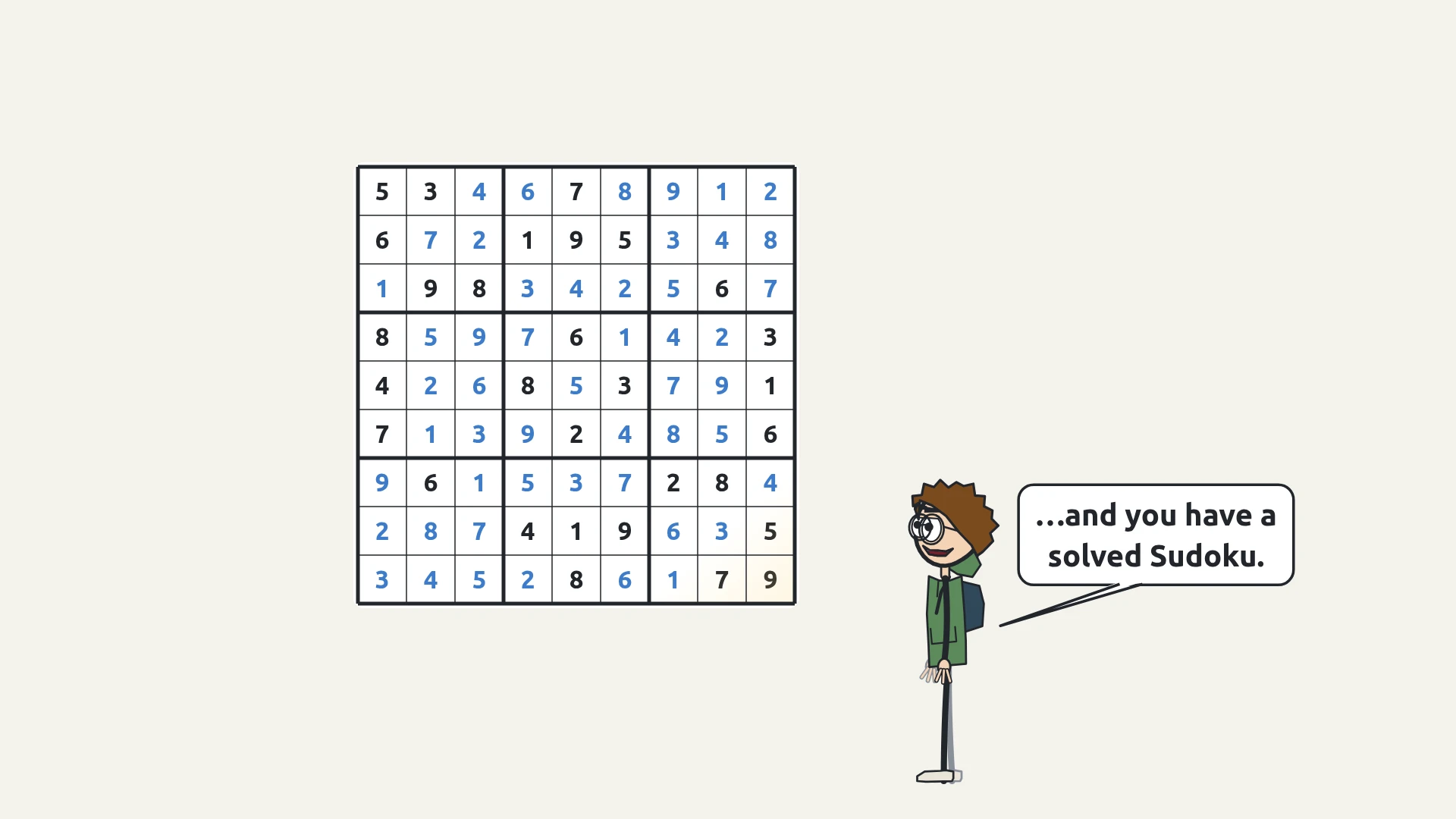
A nine-by-nine grid. Some cells already hold a digit; the rest are empty. Your job is to fill every empty cell with a digit from 1 to 9 so that three rules hold at once: each digit appears once in its row, once in its column, and once in its three-by-three box.
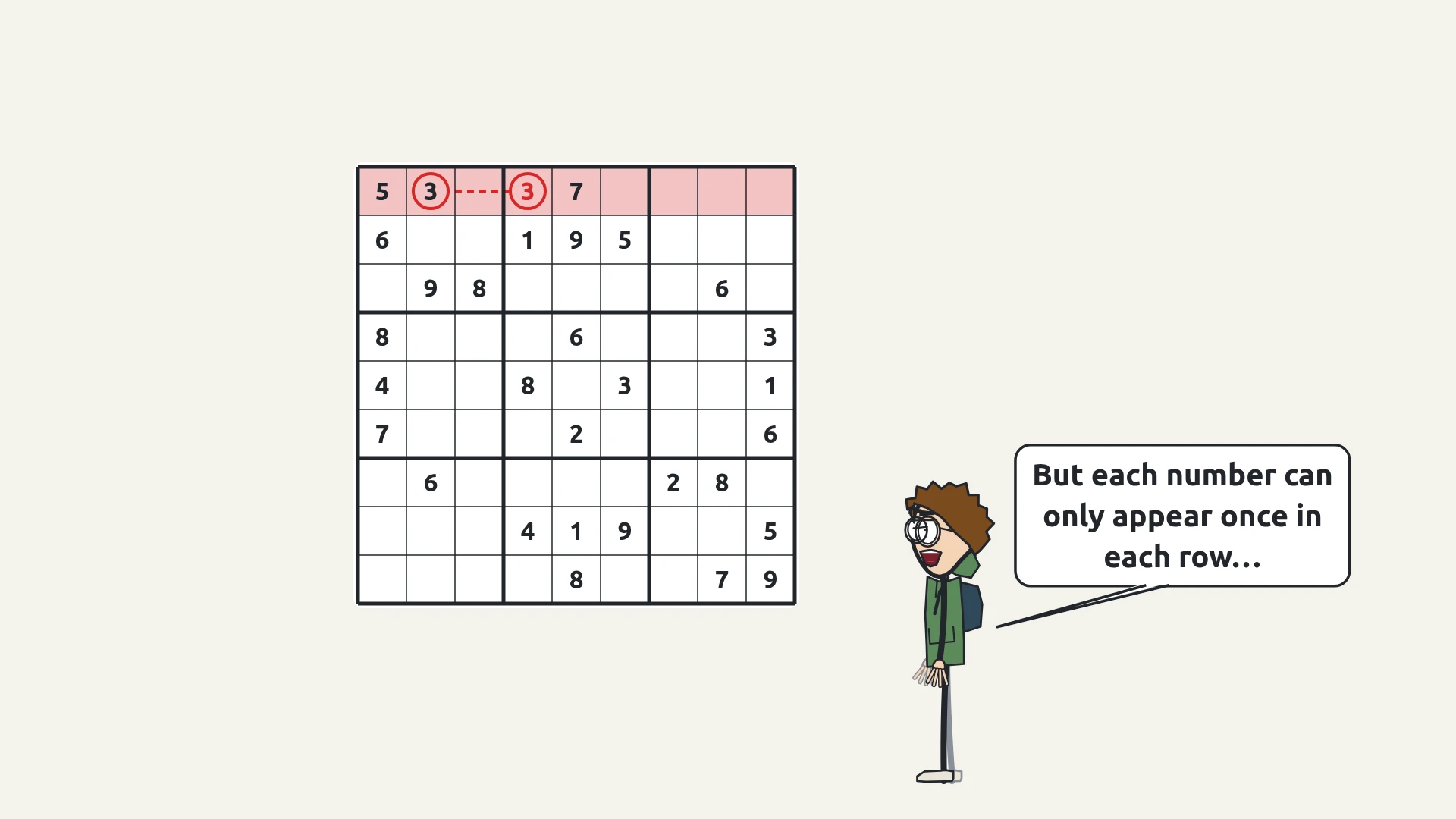
The rules are what make a digit wrong. Put a 3 in the fourth cell of the top row and it clashes with the 3 already in that row. The rules reject it before you have gone any further — remember that, because it is the only thing the computer will ever "know" about the puzzle.
A person solving this looks for cells where only one digit can go. A computer could do that too, but we are after something more general: a way to solve a puzzle when there is no clever next step, only choices.
2 · The obvious ideaMake a choice, keep going
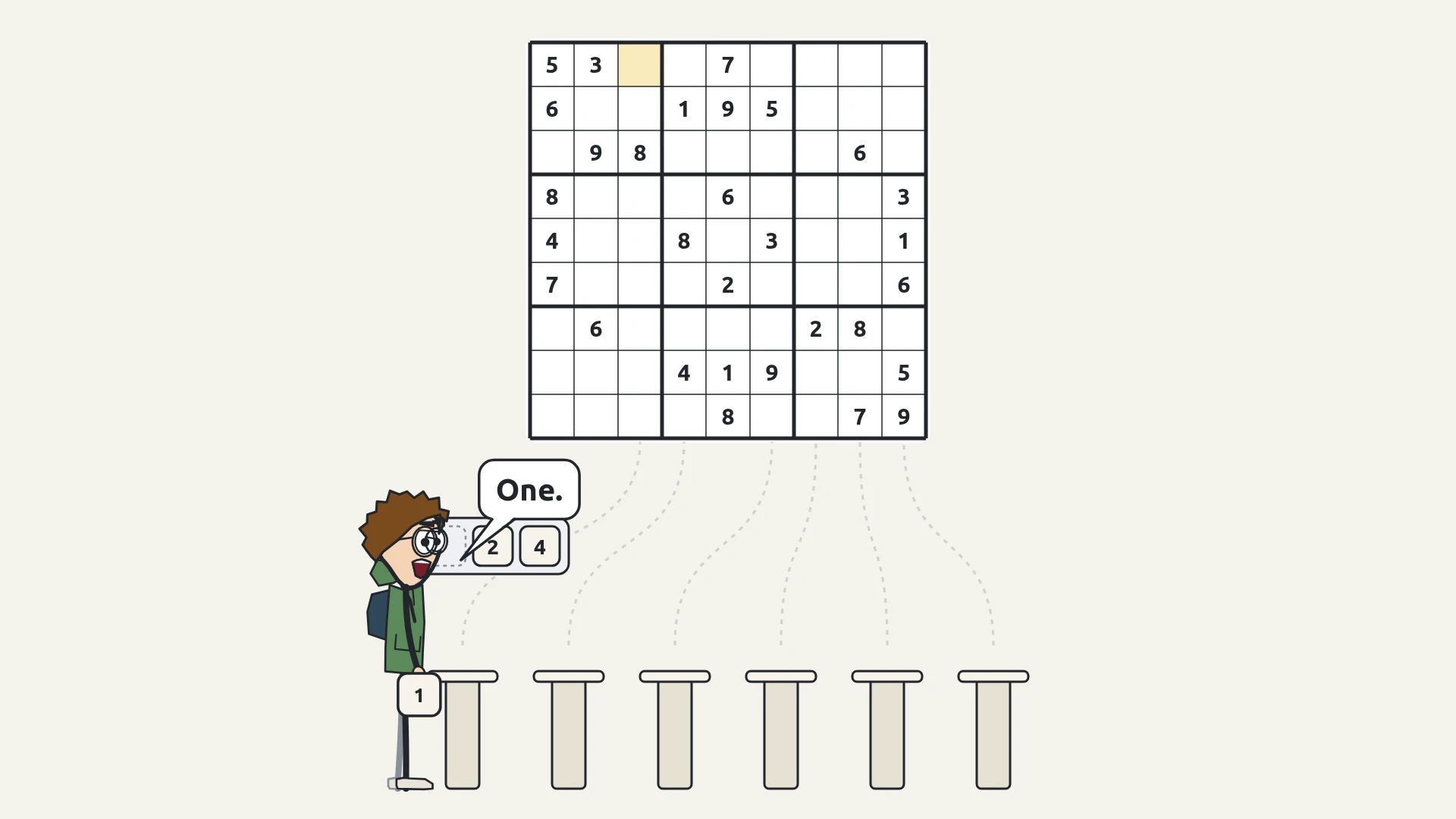
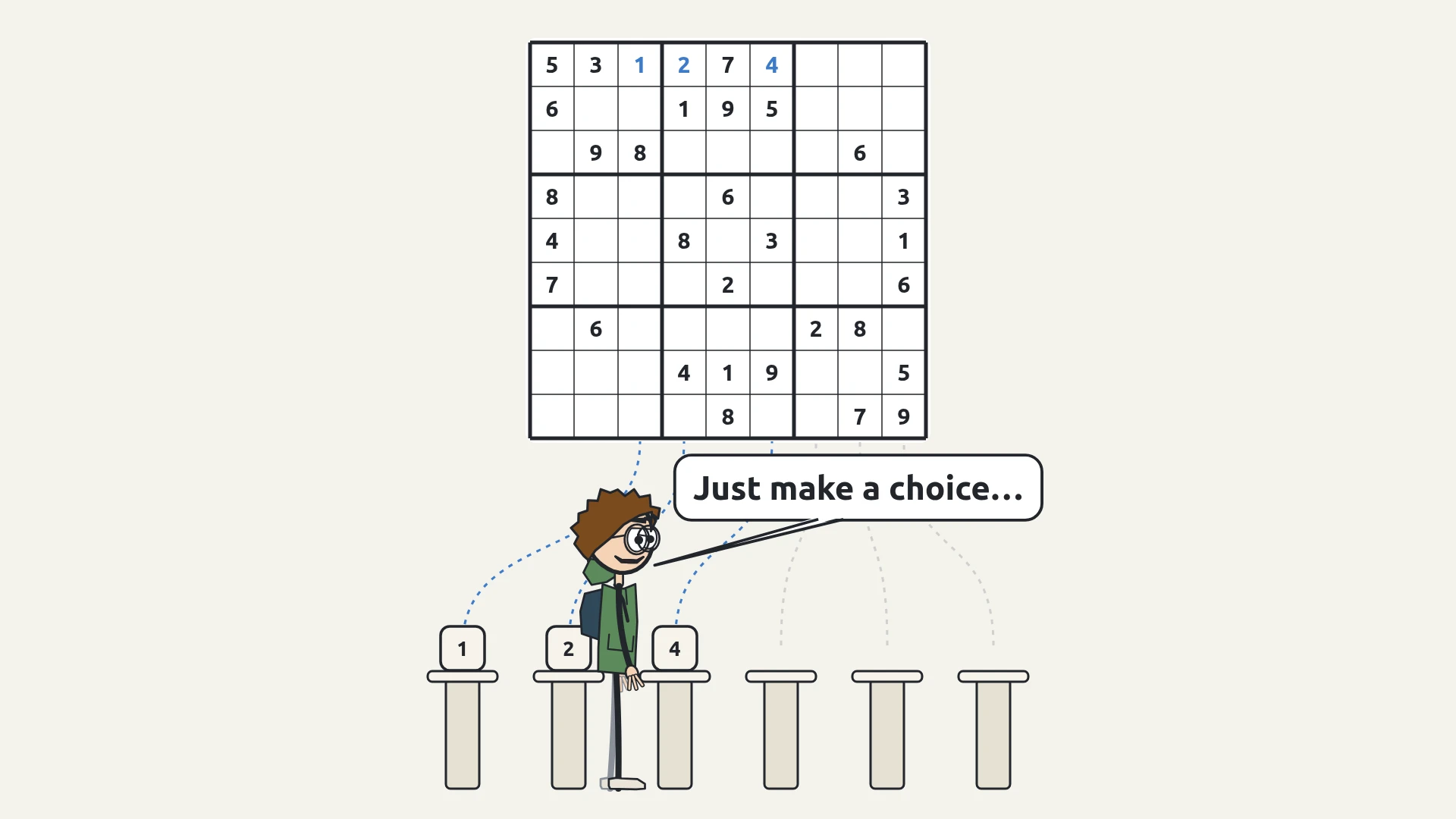
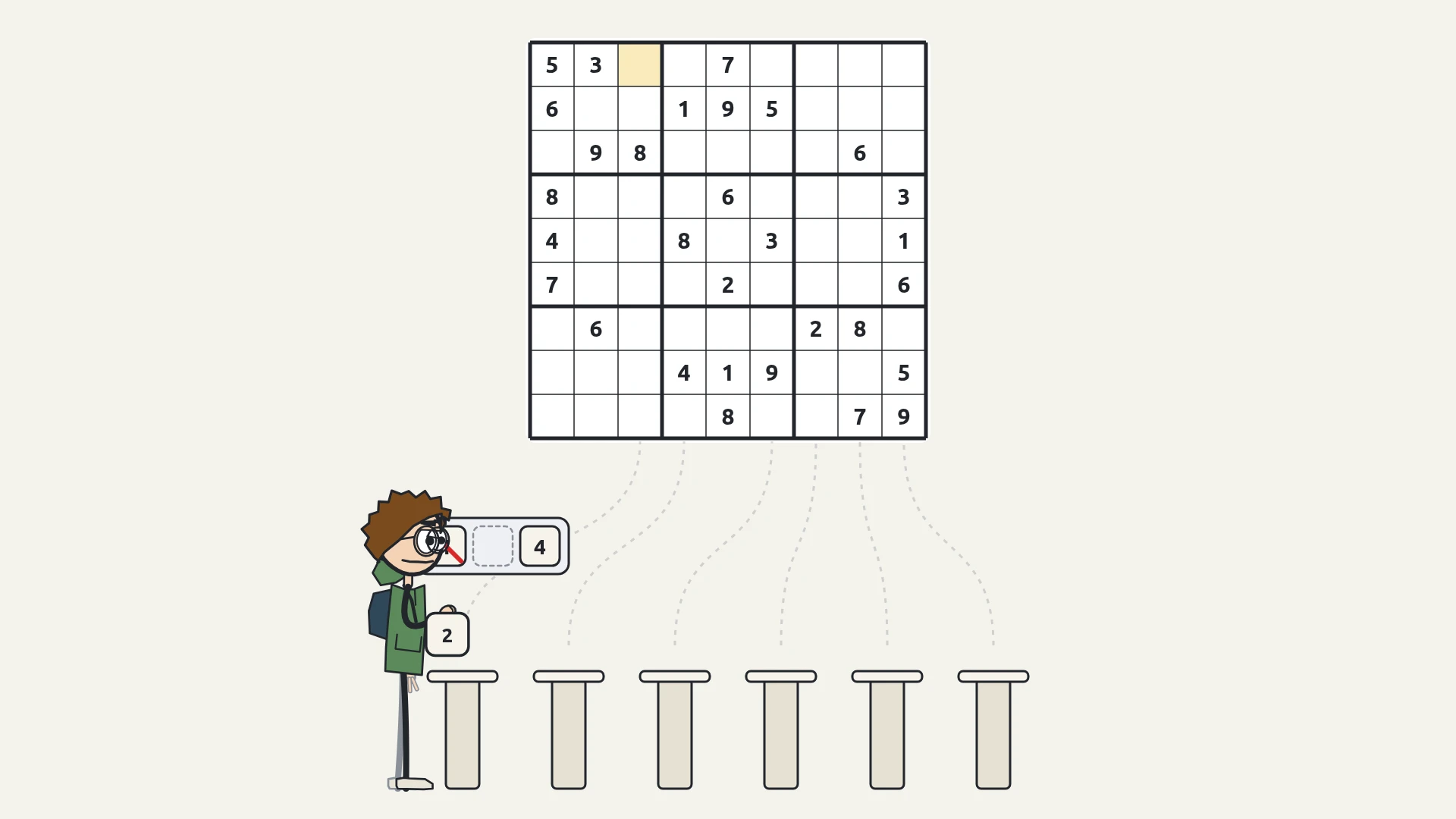
Start at the first empty cell: the third one in the top row. Which digits are not ruled out? The row already has 5, 3 and 7; the column has an 8; the box has 5, 3, 6, 9 and 8. What is left is 1, 2 or 4.
We don't know which one is right. So take the first that fits: 1. Then move on to the next empty cell and do the same thing. Just make a choice… and keep going.
It goes well. The next empty cell takes a 2, the one after it a 4, the one after that a 9. Four cells filled, no rule broken. It feels like it is working.
3 · The failureNothing fits
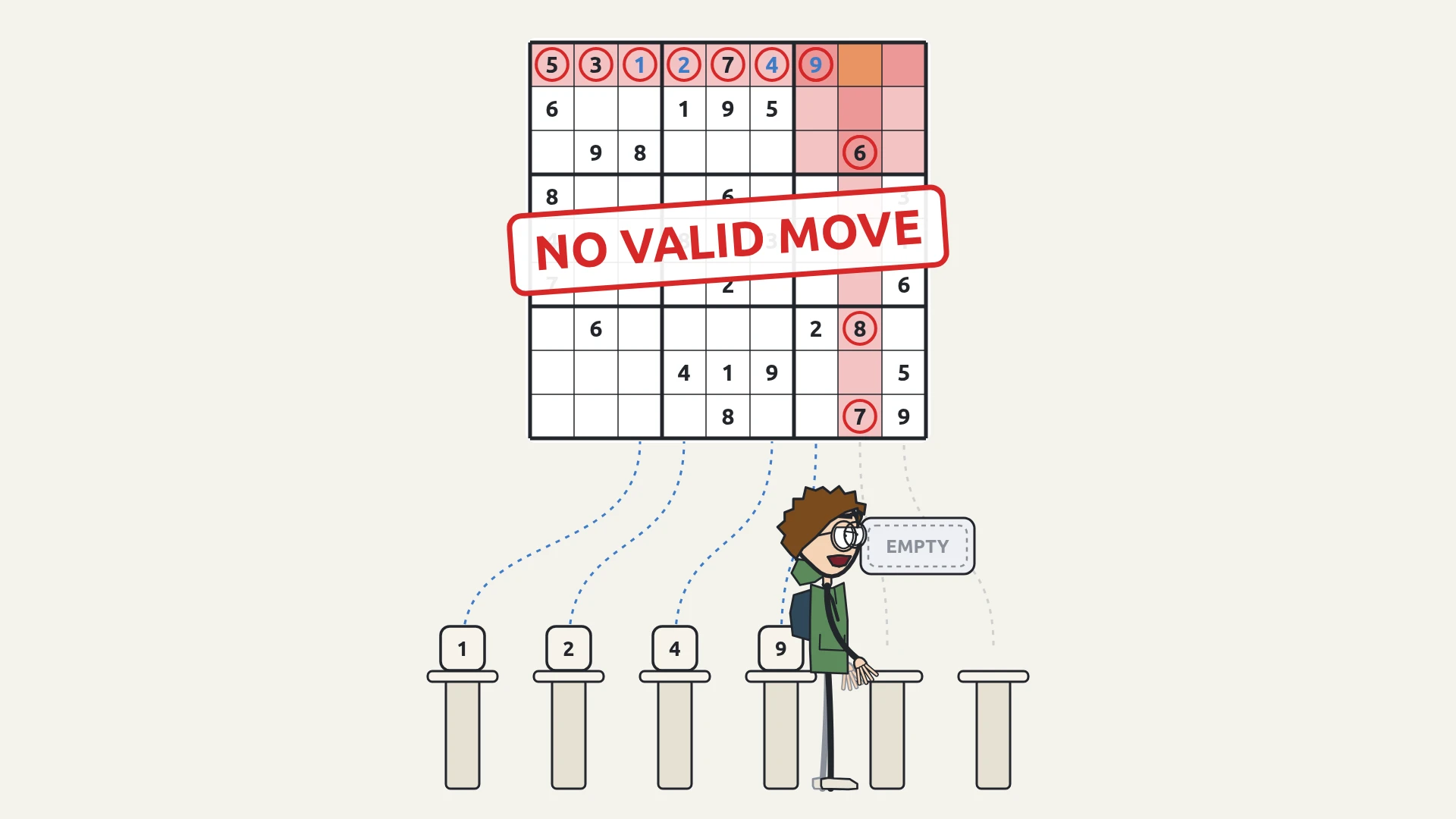
Then the next empty cell. Try 1: the row has one. 2, 3, 4, 5: all in the row already. 6: in the column. 7: the row. 8: the column. 9: the row. Every digit from 1 to 9 is ruled out. The tray is empty.
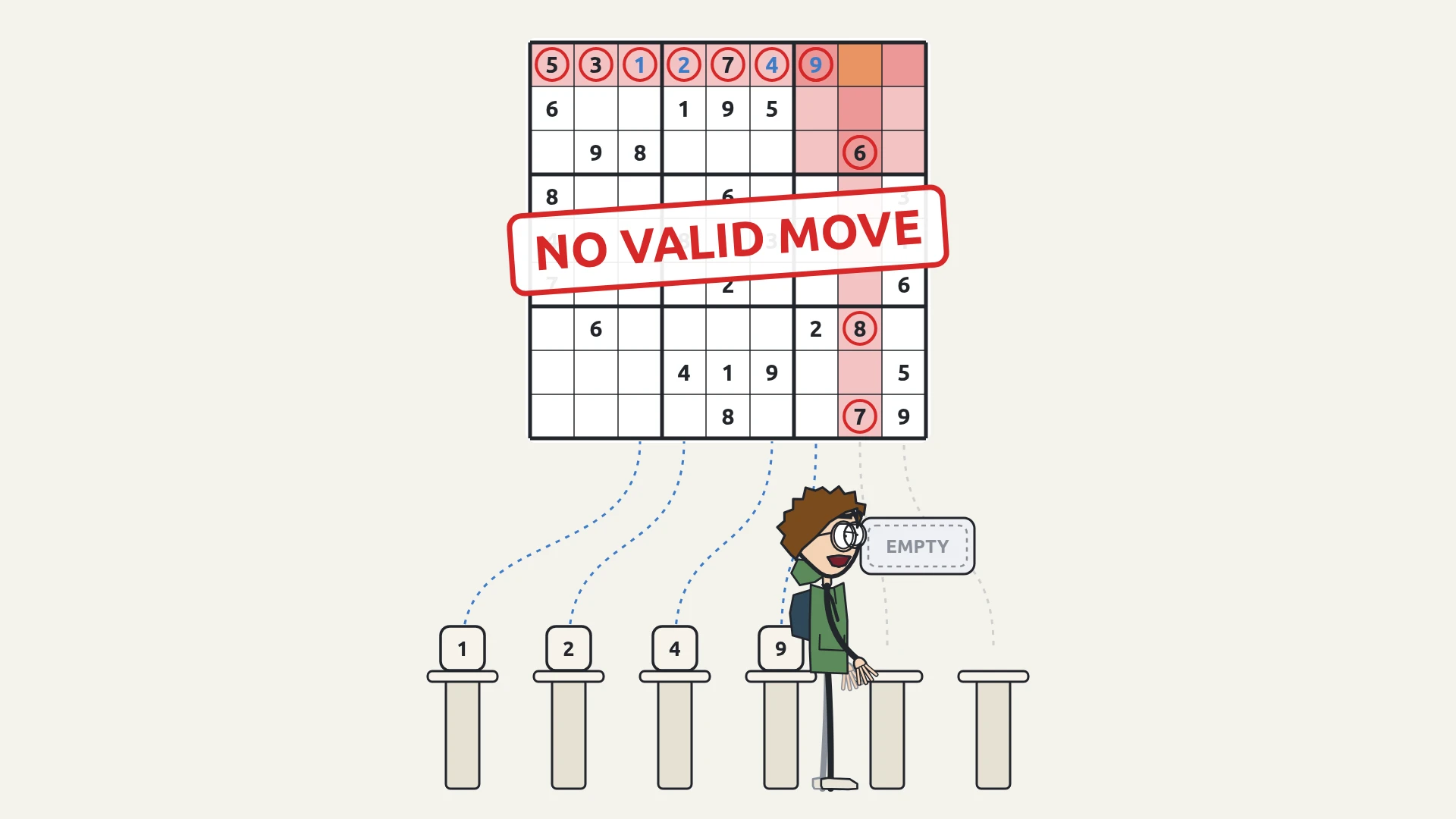
This is the moment the obvious idea breaks, and it breaks in an interesting way. Nothing is wrong with this cell. Every digit we placed was legal when we placed it. And yet here we are, with an empty cell that cannot be filled. The contradiction is real, but its cause is somewhere behind us.
4 · The observationWhich choice was wrong?
Wait. The problem is not necessarily the last thing we did. One of the earlier choices was wrong — and we have no idea which. The 9? The 4? The 2? The 1 at the very start?
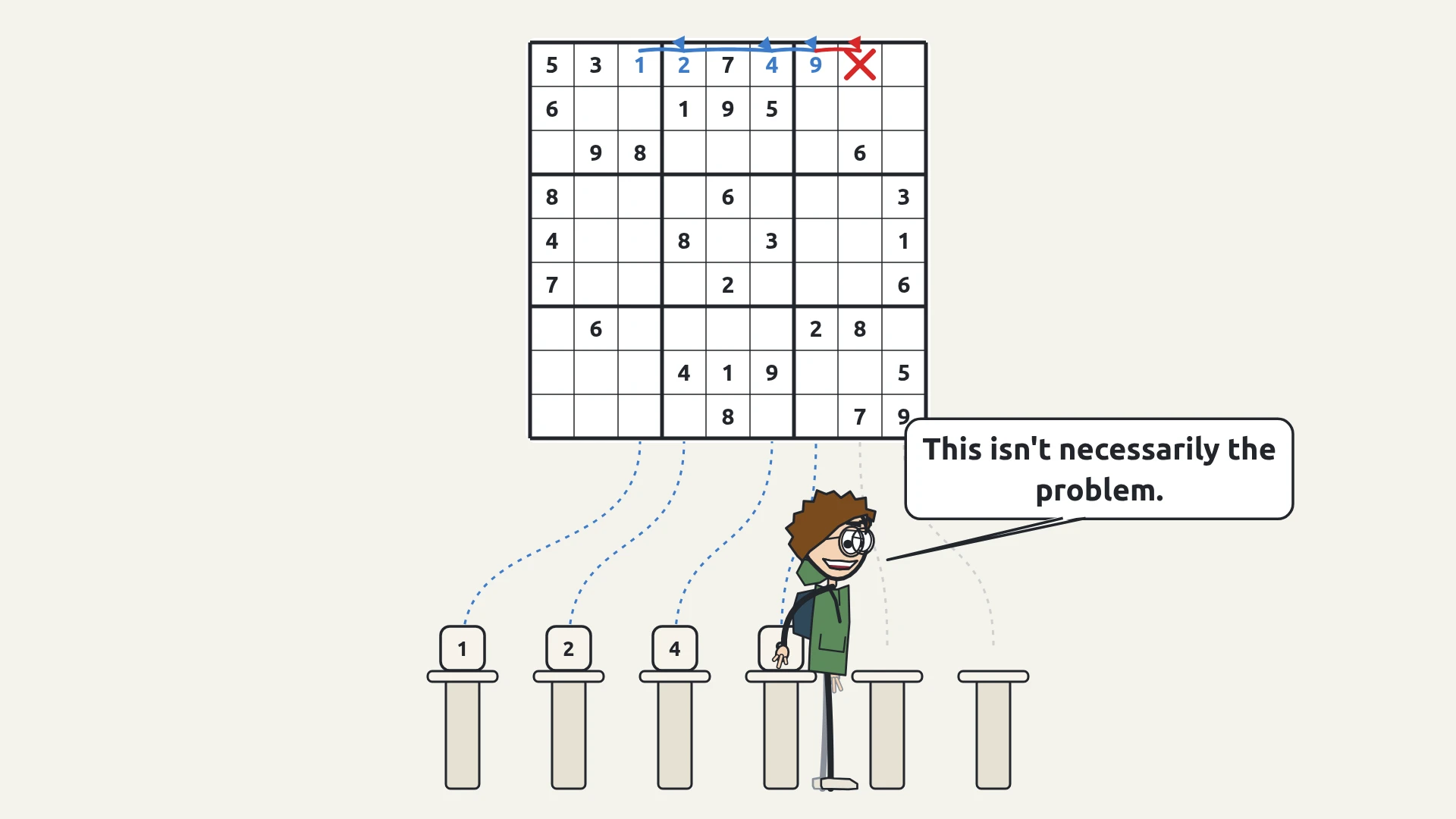
We cannot tell from here. So do the only honest thing: go back. Undo the 9. Is there another digit for that cell? If not, undo the 4. And so on — back to a choice where something else can still be tried.
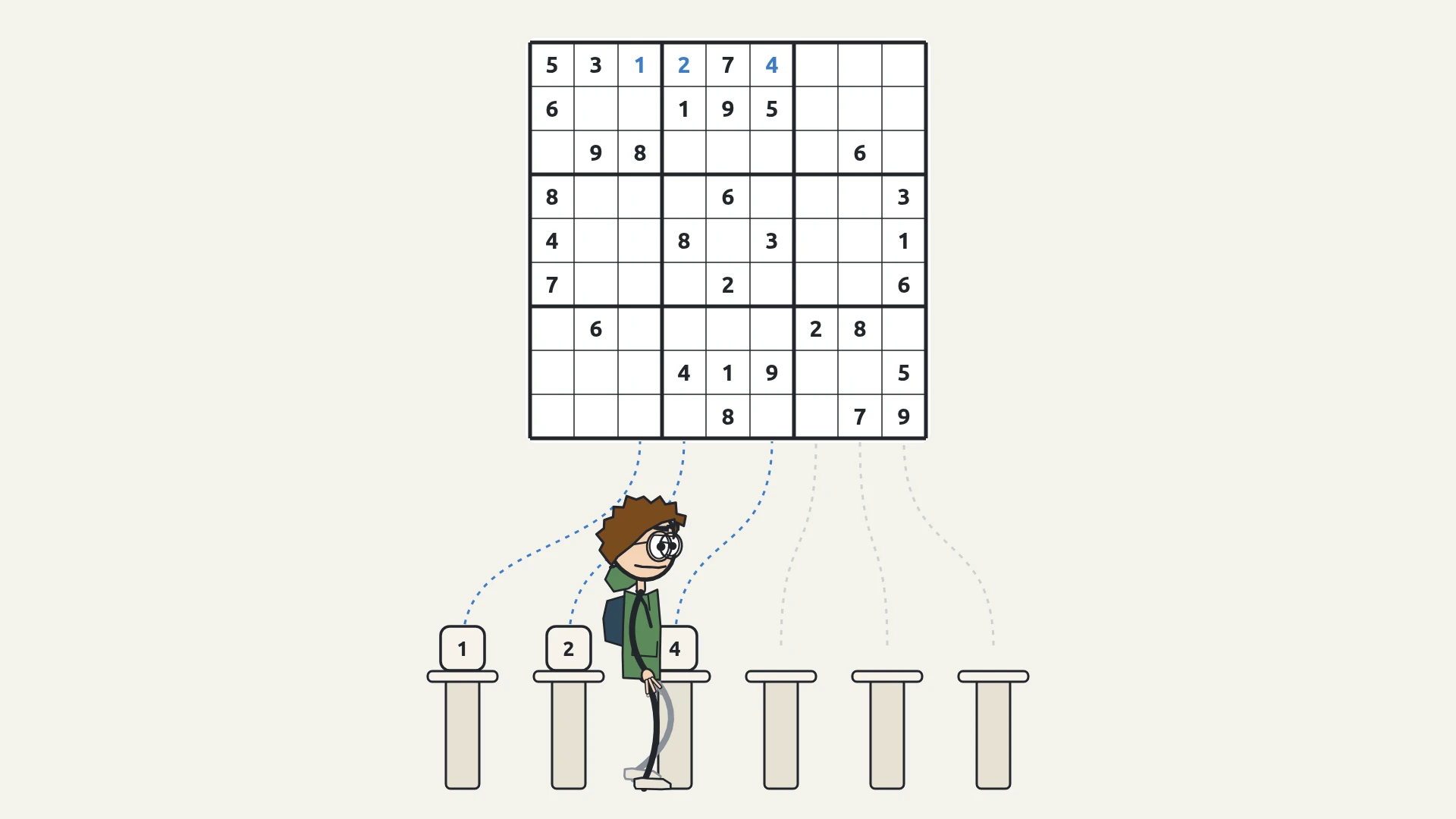
In the story he walks all the way back to the first empty cell, where 2 and 4 are still untried, and crosses out the 1. The 1 was not illegal; it just led nowhere. That is the key distinction of this whole technique: a choice can be allowed and still be wrong, and the only way to find out is to follow it until it either works or breaks.
5 · The second attemptTry another — and fail again
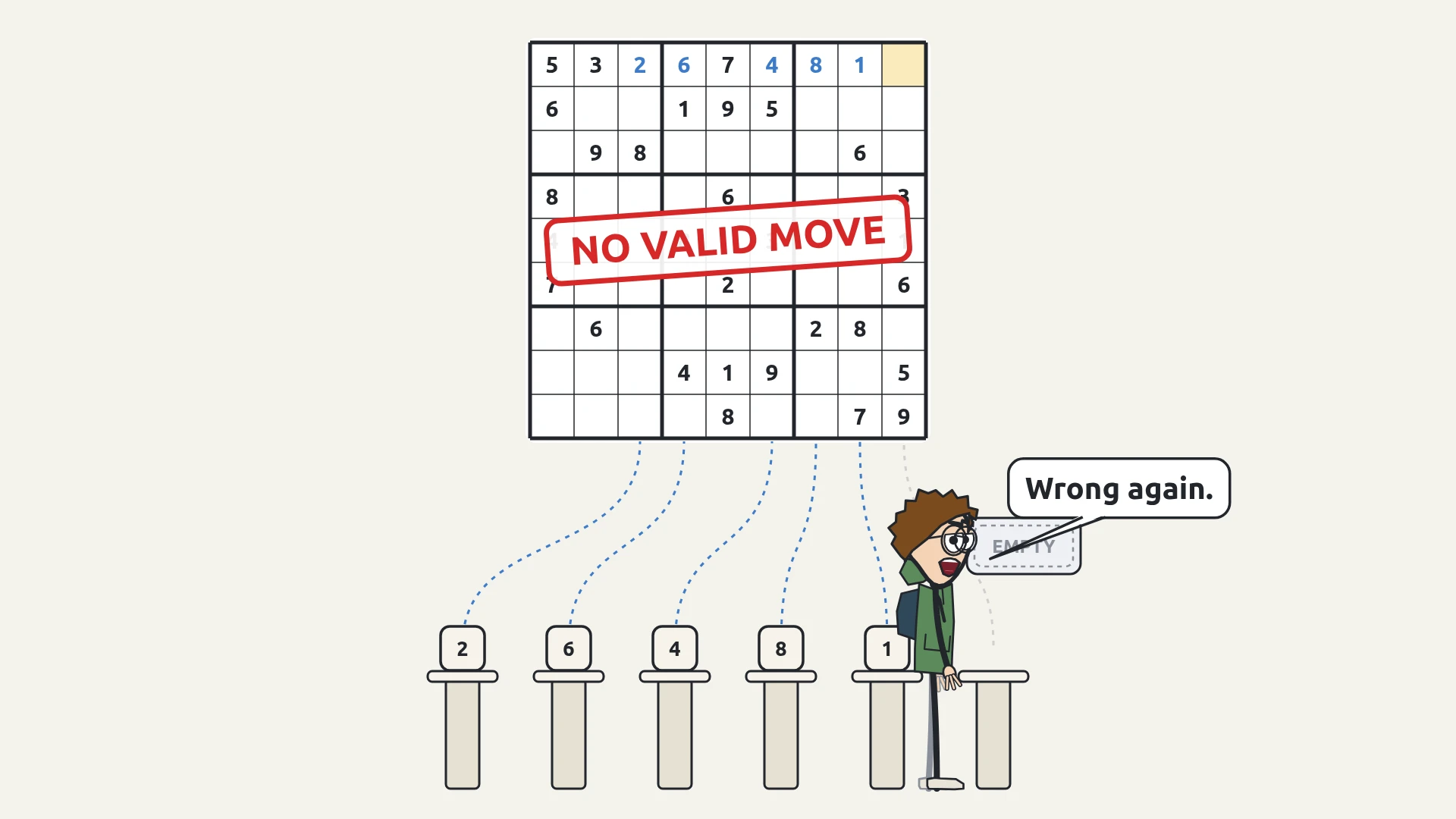
With a 2 in the first cell the next cell has only one digit left, a 6, so that one is forced. Then a 4, an 8, a 1 — and the last cell of the row has nothing left. Wrong again. A different dead end, one cell further along.
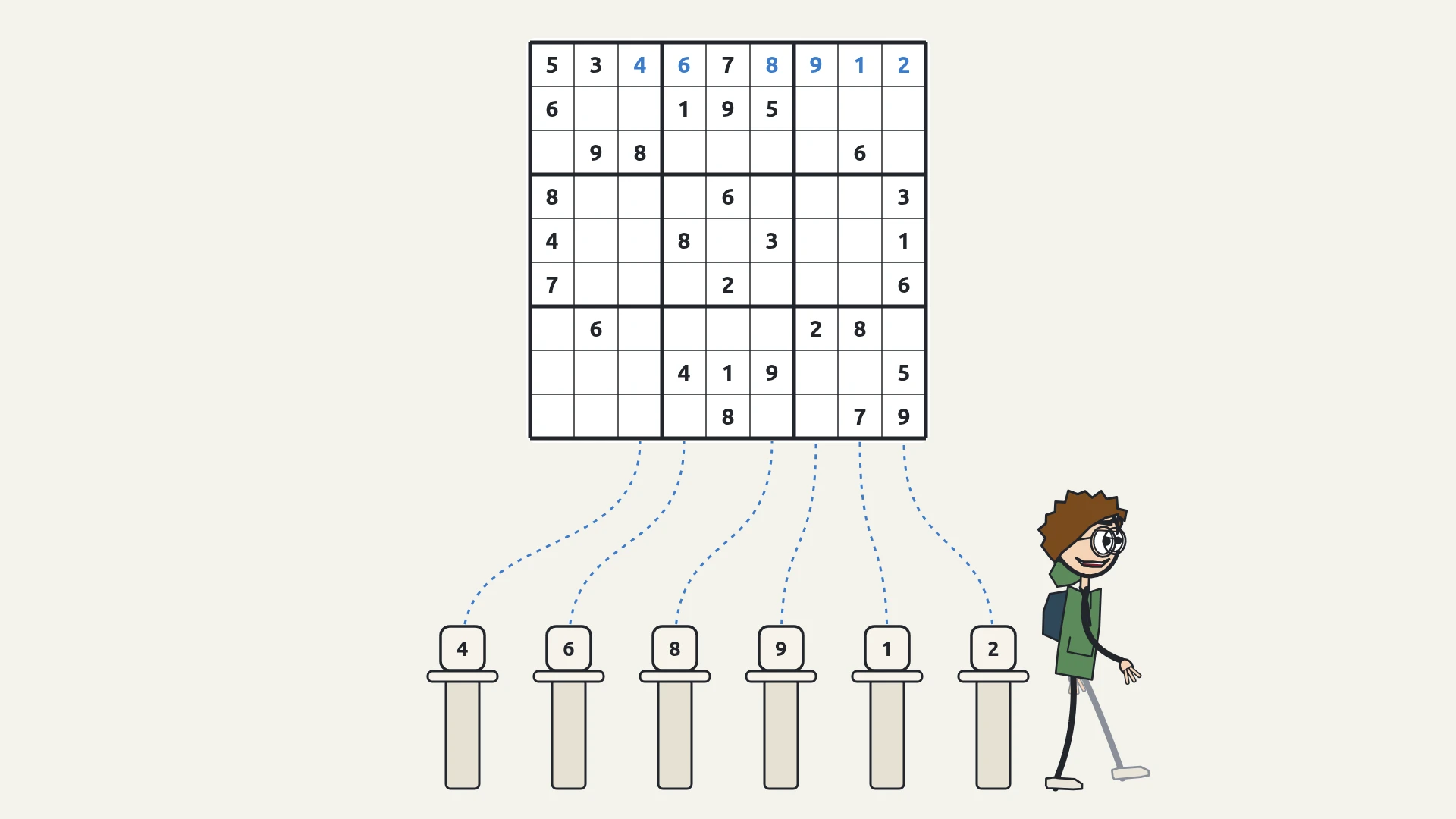
So back again, cross out the 2, and try the 4. This time: 6, 8, 9, 1, and a 2 in the last cell, the only digit that fits. The top row is complete, and every rule holds.
Notice what we never did: we never knew the right digit in advance, and we never needed to. We needed a way to recover from the wrong one.
6 · The discoveryYou are exploring a path
Step back and look at what the attempts form. The first cell had three choices; each of those led to a different set of choices in the next cell, and so on. Every choice opens up more possibilities, and every possibility is itself a choice. The attempts are not guesses — they are paths through a tree.
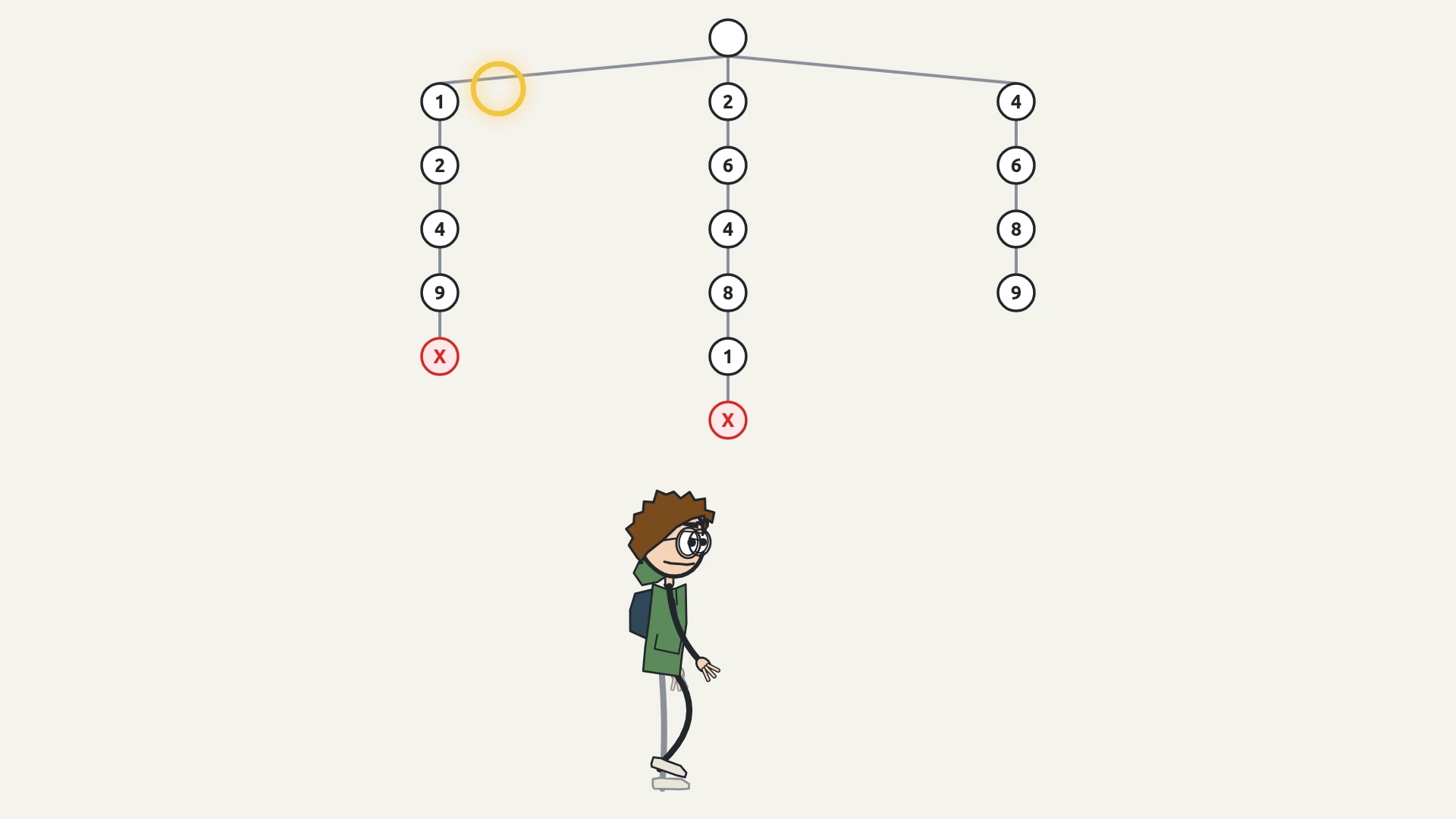
Seen like this, "go back" has a precise meaning: when a path breaks, return to the last fork where an untried branch remains, and take it. You are not guessing once. You are exploring a tree, one path at a time, and pruning the paths that break.
Make a choice. Explore it. If it leads nowhere, undo it and try the next one. A wrong path is not a failure — it is a branch of the tree you can now rule out.
7 · The nameThis is backtracking
Only now does the technique deserve its name. Backtracking: build a solution one choice at a time; whenever the partial solution can no longer be completed, step back to the most recent choice and change it. The name is literal. When the track ends, you track back.
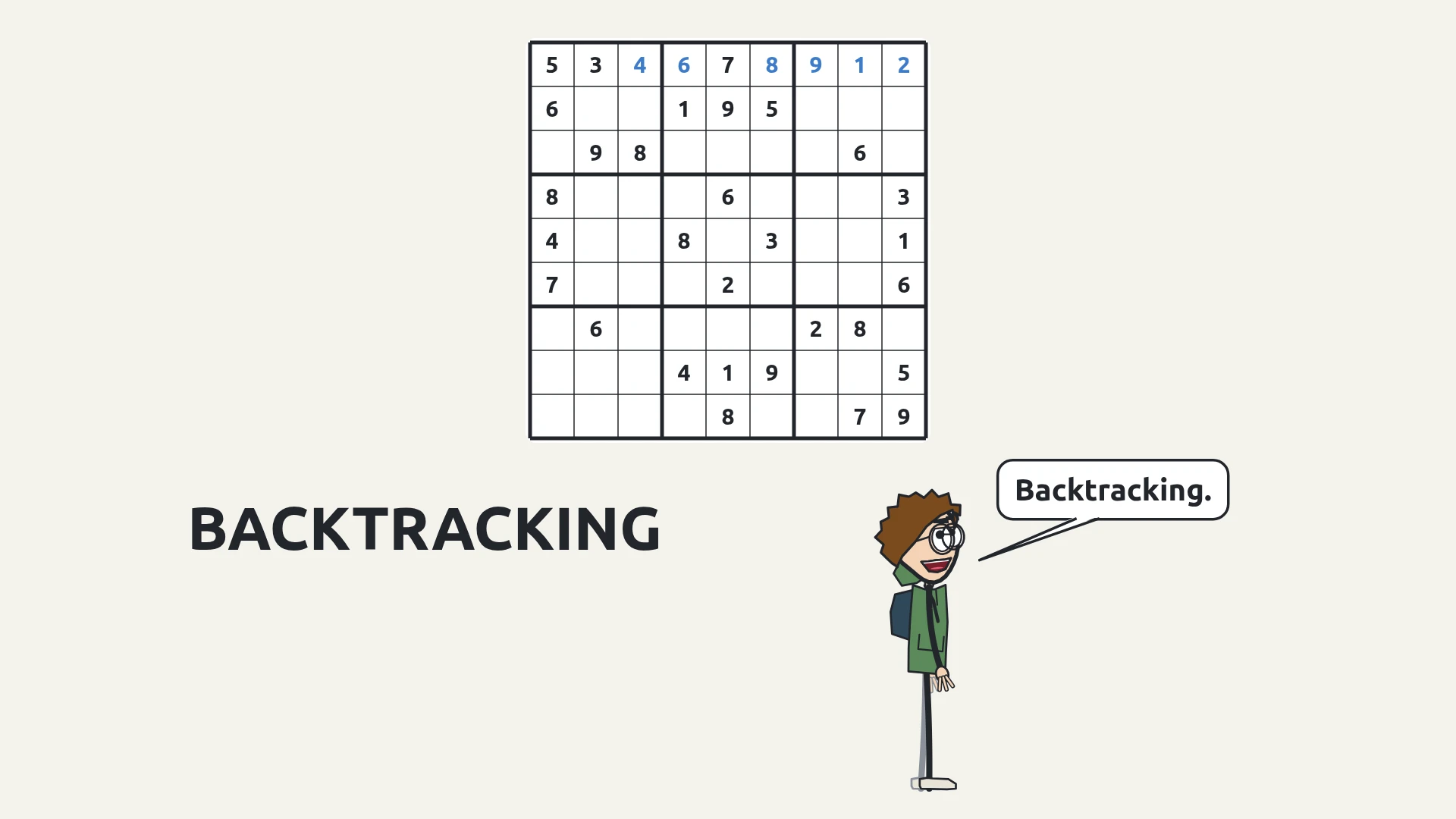
The whole loop fits on one hand:
- Choose
Pick the next decision to make — here, the next empty cell.
- Try
Take the first option the rules still allow, and make it real on the board.
- Keep going
Move to the next decision as if the choice were right. If there are no decisions left, you are done.
- If it fails, undo
A dead end means some choice behind you was wrong. Take the most recent one back.
- Try the next option
At that same decision, the next allowed option. If there is none, undo one more.
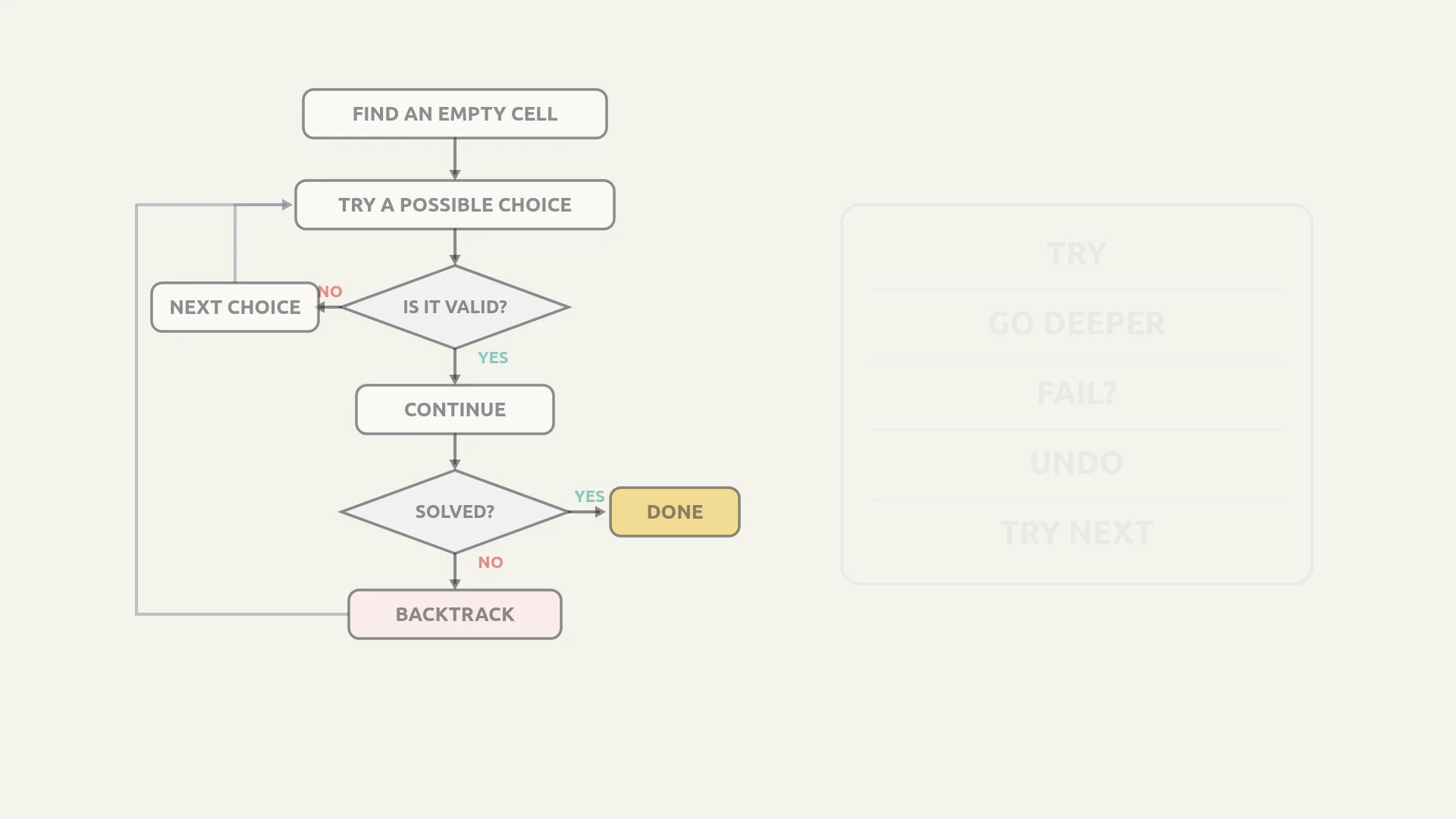
8 · The distinctionNot starting over
Backtracking does not mean wiping the board and beginning again. When the 2-path broke at the end of the row, only the choices that depended on the 2 were undone — the 6, the 4, the 8, the 1. The thirty given digits never moved, and neither would any cell filled before the bad choice. You only undo the choices that depend on the wrong decision.
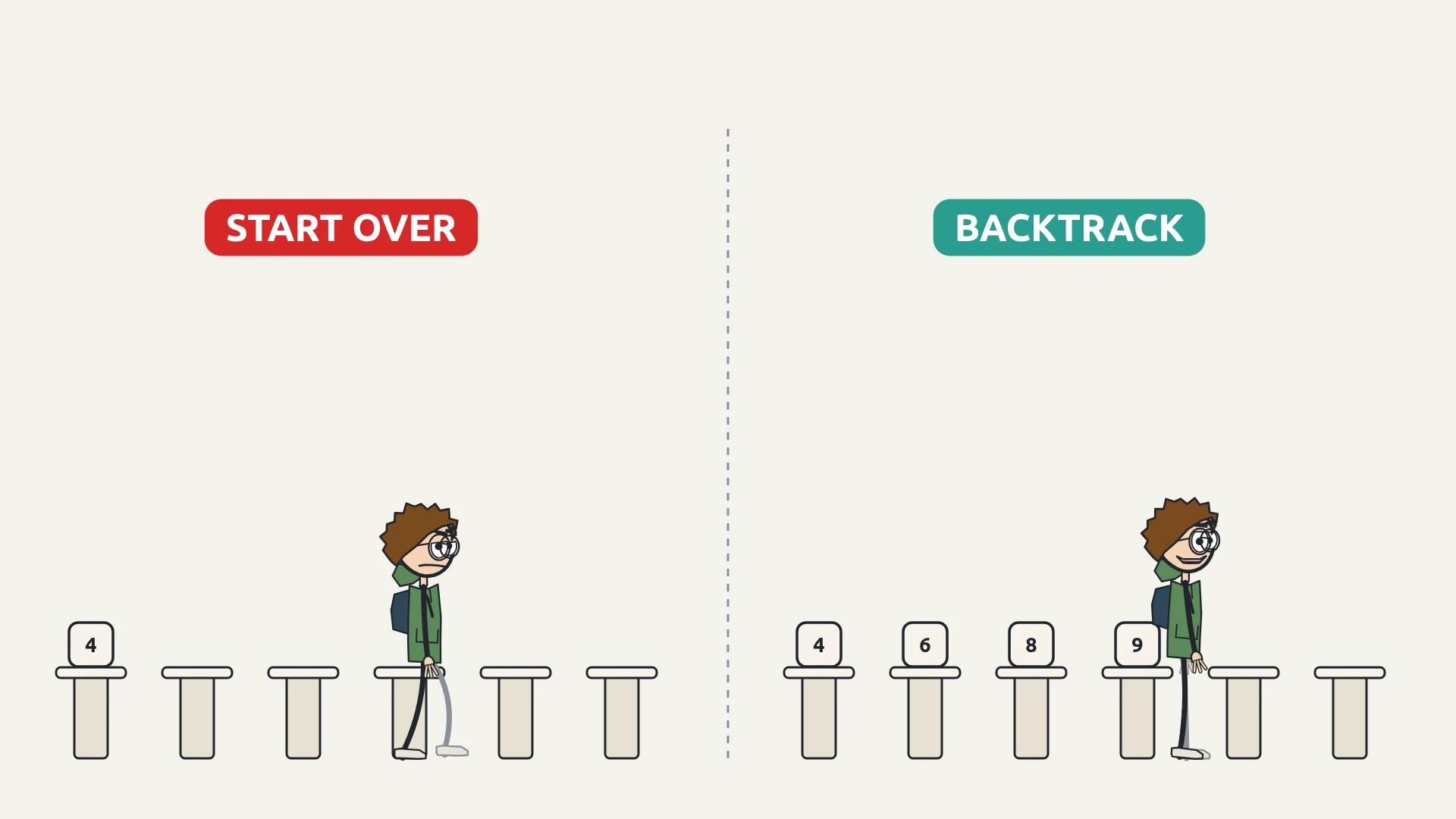
In the story he walks all the way back to the first cell and crosses out the 1. The program is more careful than the story: it goes back one choice and tries the next digit there first. With a 1 in the first cell, the program tries a 9 instead of the 8 in the seventh cell, fails again, then steps back further. It makes 333 placements before it has exhausted every path that starts with a 1, and 2,207 before it gives up on the 2 and finally places the 4. The walk back in the film is the shape of the idea; the numbers here are the program's.
9 · The codeTranslate what we did into Python
The board is a nine-by-nine list of lists of characters: a digit, or '.' for an empty cell. The board itself is the whole state — there is no separate record of the path, because the path is the digits currently on the board.
Build the solver from the loop above, one piece at a time.
Find an empty cell
Scan row by row, cell by cell. A cell that already holds a digit is skipped. The first empty cell found is the decision to make now.
def solve(): for r in range(9): for c in range(9): if board[r][c] != '.': continueTry every digit
For that cell, go through the digits 1 to 9 in order. A digit that breaks a rule is skipped before anything else happens — this is the tray with some digits missing.
for num in "123456789": if not valid(r, c, num): continueWhat makes a digit valid?
Three loops, one per rule: the row, the column, the three-by-three box. The box's top-left corner is found by rounding the row and column down to a multiple of three.
def valid(r, c, num): for j in range(9): if board[r][j] == num: return False for i in range(9): if board[i][c] == num: return False box_r = (r // 3) * 3 box_c = (c // 3) * 3 for i in range(box_r, box_r + 3): for j in range(box_c, box_c + 3): if board[i][j] == num: return False return TruePlace it, go deeper, and if that fails, undo
This is where the story becomes recursion. Put the digit on the board, then call solve() again to fill the rest. If that call comes back True, the rest got filled and we are done — pass the True upward. If it comes back False, every path through this digit broke somewhere ahead, so take the digit back off the board and let the loop try the next one.
board[r][c] = num if solve(): return True board[r][c] = '.'Line 36 is the single most important line in the file: board[r][c] = '.'. It is the digit lifted off the board. Without it, the board would still show the wrong digit when the loop tried the next one, and the "walk back" would never happen.
No digit works
If the loop finishes without any digit leading to a solution, this cell cannot be filled with the board as it stands — someone before us chose wrongly. Say so: return False. And if the scan never found an empty cell at all, the board is full and every rule held along the way: return True.
return False return TrueThe whole thing
def solve_sudoku(board): def valid(r, c, num): for j in range(9): if board[r][j] == num: return False for i in range(9): if board[i][c] == num: return False box_r = (r // 3) * 3 box_c = (c // 3) * 3 for i in range(box_r, box_r + 3): for j in range(box_c, box_c + 3): if board[i][j] == num: return False return True def solve(): for r in range(9): for c in range(9): if board[r][c] != '.': continue for num in "123456789": if not valid(r, c, num): continue board[r][c] = num if solve(): return True board[r][c] = '.' return False return True solve()Every line is something that happened on the board. The table the video ends on says the same thing twice:
| In the story | In the code |
|---|---|
| Find an empty cell | if board[r][c] != '.': continue |
| Try a choice | for num in "123456789": |
| Check if it is possible | valid(r, c, num) |
| Make the choice | board[r][c] = num |
| Keep going | solve() |
| It worked | if solve(): return True |
| It failed | solve() returned False |
| Undo | board[r][c] = '.' |
| Try another | the next turn of the for num loop |
| No choice works | return False |
| Everything solved | return True |
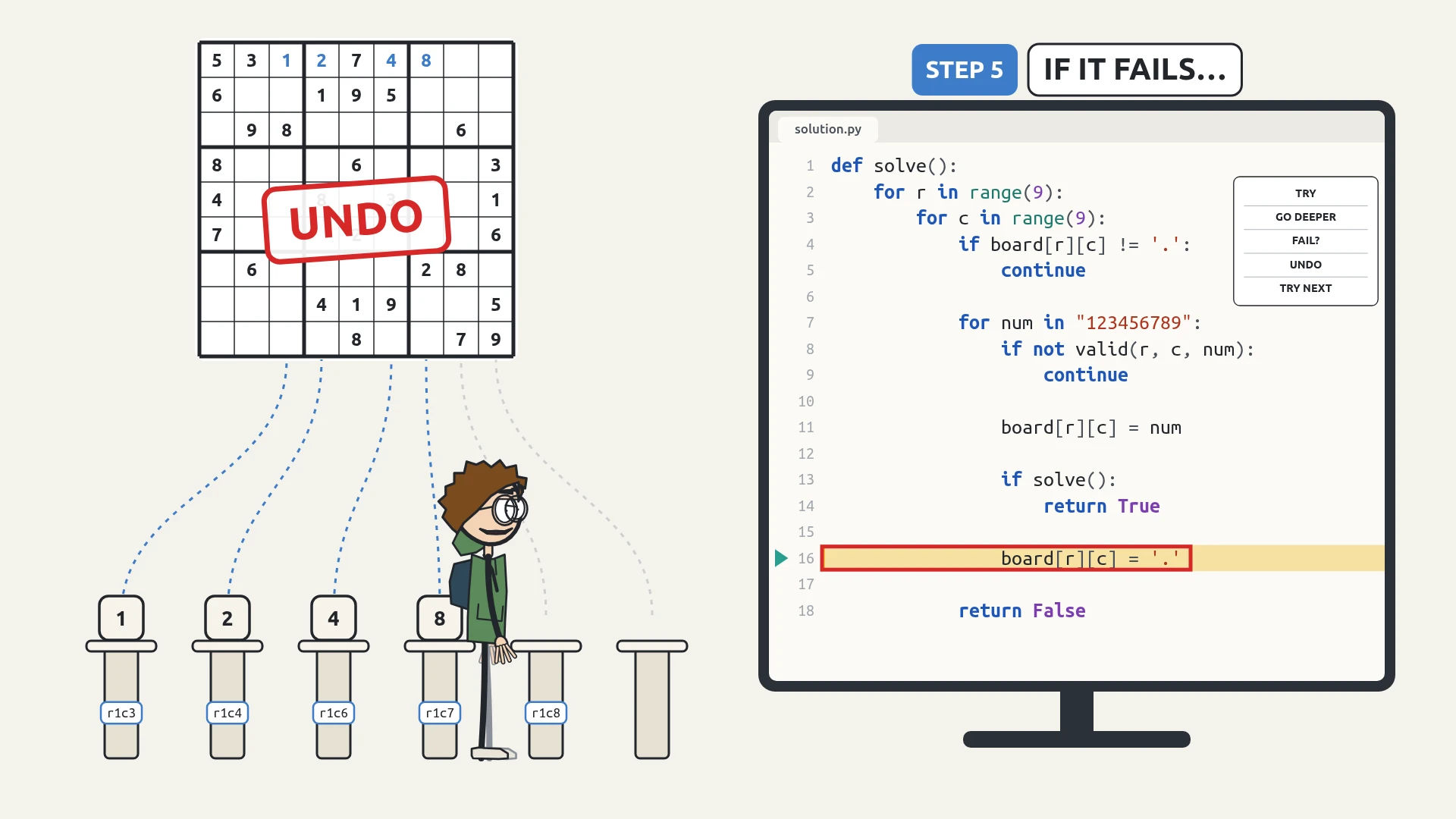
10 · The programming insightWho walks back? The call stack
In the story, the walk back is a thing he does: a step at a time, lifting a digit at each post. In the code there is no "walk back" anywhere. So who does it?
Python does. Every solve() call that places a digit calls solve() again for the rest of the board, which calls solve() again, and so on — a stack of calls, one per placed digit. When the deepest call returns False, control goes back to the call before it, which is still standing on its own line 34 with its own r, c and num. That call lifts its digit on line 36 and tries the next one. If it runs out, it returns False too, and control steps back once more.
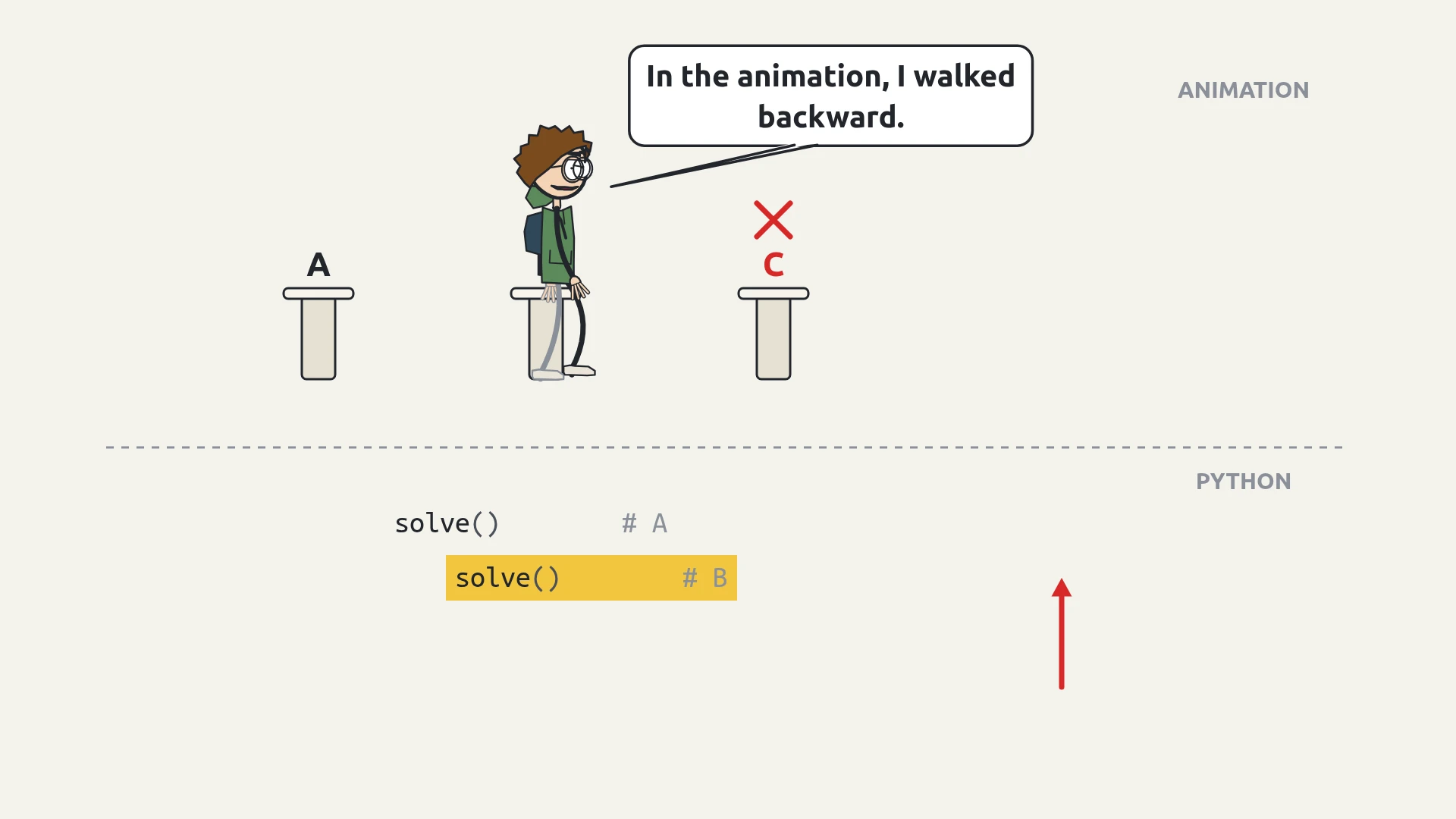
So failure travels backwards through the stack on its own, one level per False, until it reaches a call that still has digits to try. The recursion is not a trick to make the code short. It is the data structure that remembers where every fork was and what has been tried at each — for free.
11 · The costWhat it costs
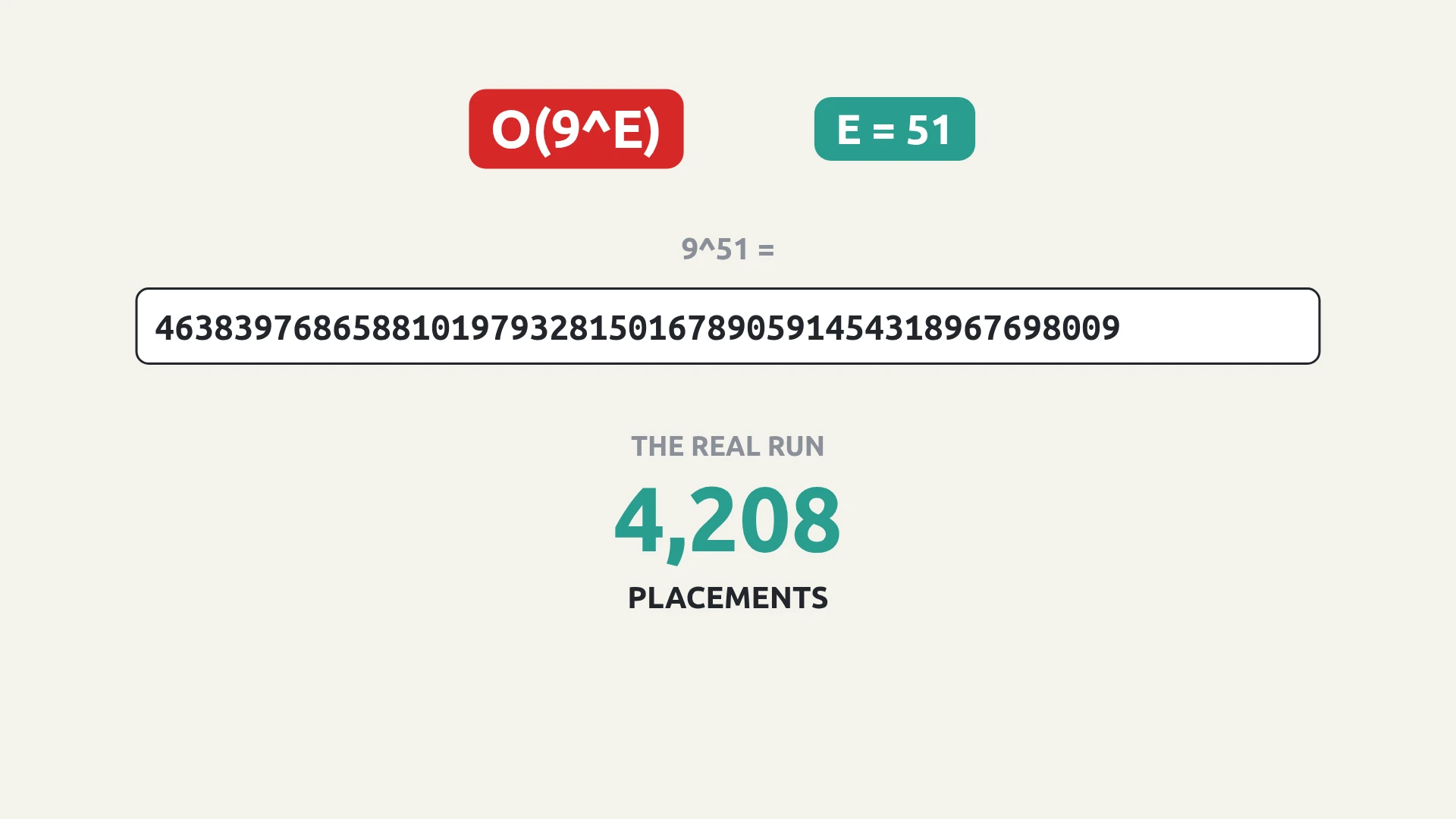
Up to nine choices at each of the empty cells, one after another: in the worst case the tree has 9 × 9 × 9 … paths, one factor per empty cell — 9E for E empty cells. Our board has 51, and 951 is a number with 49 digits. Nothing can explore that.
Nothing has to. Every valid() that says no cuts off a whole branch before a single step is taken down it. On this board the program places a digit 4,208 times in total — wrong placements included — and arrives at the solution.
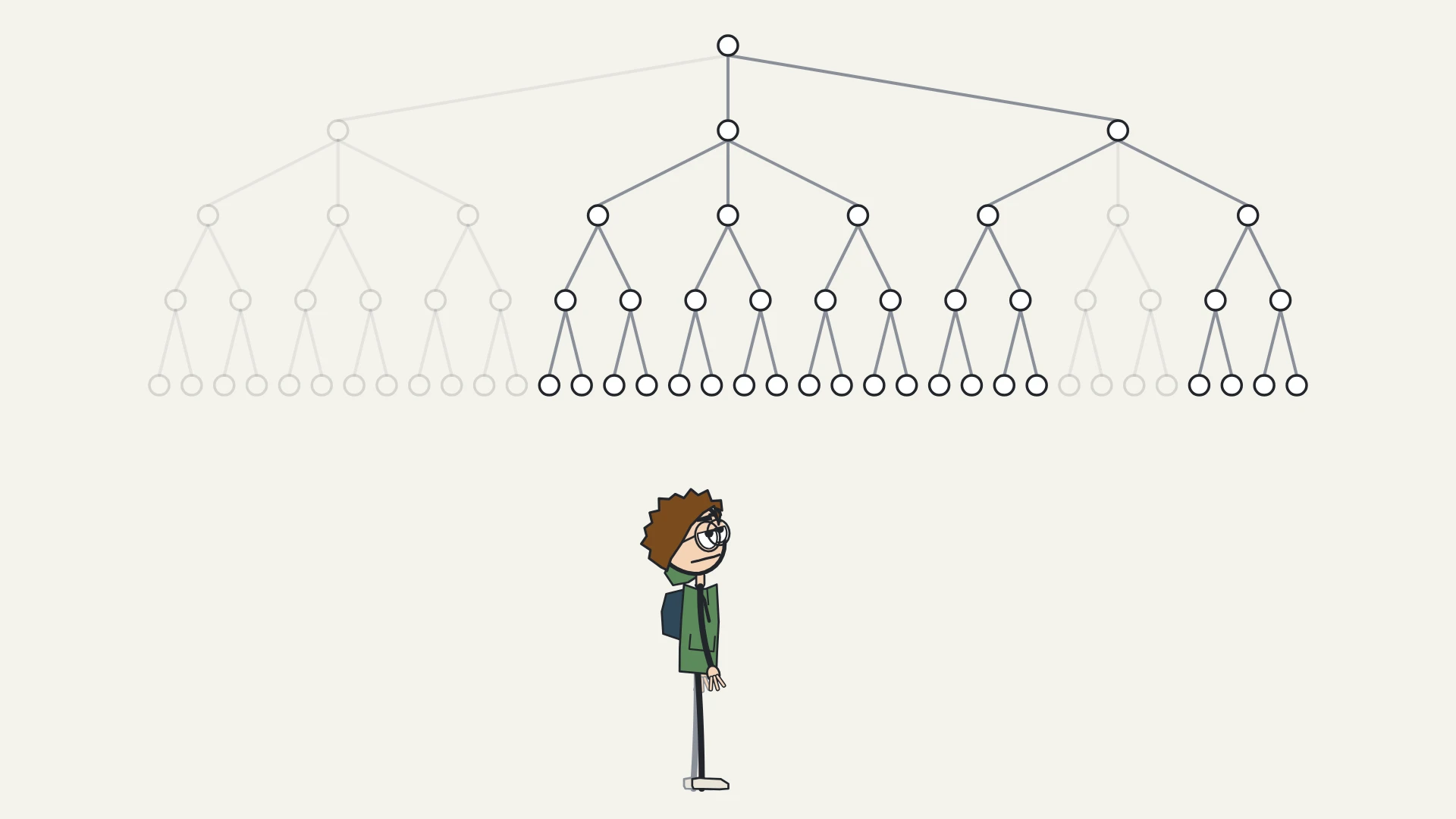
That is the lesson about cost, and it is the same lesson as the technique: backtracking becomes practical exactly to the degree that you can reject bad paths early. Sudoku is generous here — three rules, each a cheap check. A problem with weaker rules prunes less and costs more.
4,208 placements for 51 cells is still eighty tries per cell. The program always picks the first empty cell. What if it picked the cell with the fewest allowed digits instead? That one change takes the run from 4,208 placements to 51 — one per cell, no wrong guess at all. That is part 2.
12 · Watch it runThe program, live
The real run on the real board
This is the Python above, translated to run in your browser, on the same board. Placed digits are purple; the yellow cell is the one being decided; a red flash is a dead end about to be undone. Speed it up to see the shape of the search, slow it down to see single choices.
13 · The lessonTwo questions for any problem like this
The important part of this problem is not the Sudoku, and not the recursion. It is realizing that you can make progress on a problem whose right answer you cannot see, as long as you can recognize a wrong one and take it back. Don't start by writing code. Answer two things first:
- What are my choices?
At each step, what are the options I could take? Here: a digit from 1 to 9 for the current empty cell. In another problem: a letter for a position, a queen for a column, a coin for a slot.
- What makes a choice impossible?
The rule that lets me reject an option early, before exploring it. Here: a repeat in the row, the column or the box. The stronger this rule, the smaller the tree you actually walk.
Answer those and the code is the loop from section 7 with your answers filled in: choose, try, go deeper, undo, next. If you can also say when you are done — here, no empty cell left — you have everything.
14 · PracticeFour problems, same shape
None of these mention a board. For each, write down your choices and your rejection rule before touching the keyboard.
- Warm-upPermutations
Given a few distinct numbers, list every possible order of them. The choice is "which unused number comes next"; the rejection rule is "already used". No dead ends here — every path reaches the end — which makes it the cleanest place to feel the undo.
- PracticeThe Sudoku solver, from scratch
Close this page and write
validandsolveyourself. Then count the placements on this board; you should get 4,208. If you get a different number, your loop visits cells in a different order — find out why. - VariationWord search
A grid of letters and a word: can the word be spelled by a path of neighbouring cells, each used once? The choice is "which neighbour next"; the rejection rule is "wrong letter, or already on the path". Same undo, different board.
- ChallengeN queens
Place N queens on an N-by-N chessboard so that none attacks another. Decide what one "choice" is (a whole column makes it easy), what a clash is, and how early you can detect one. Then count your dead ends.
Next — Part 2: the same solver, a smarter order →
4,208 placements to fill 51 cells is a lot of wrong guesses. Part 2 keeps every idea of this program and changes one decision — which empty cell to fill first — and watches the search shrink to 51 placements.
Make a choice. If it fails, go back. Try again. Don't fear the wrong path.