
Watch the video version
Under four minutes: the sums done the slow way, the window pulled in from the storeroom and pushed along the row, then the code built line by line beside it. The written version below keeps the whole program in one place and lets you slide your own window.
Watch on YouTube1 · The problemThe biggest average of three
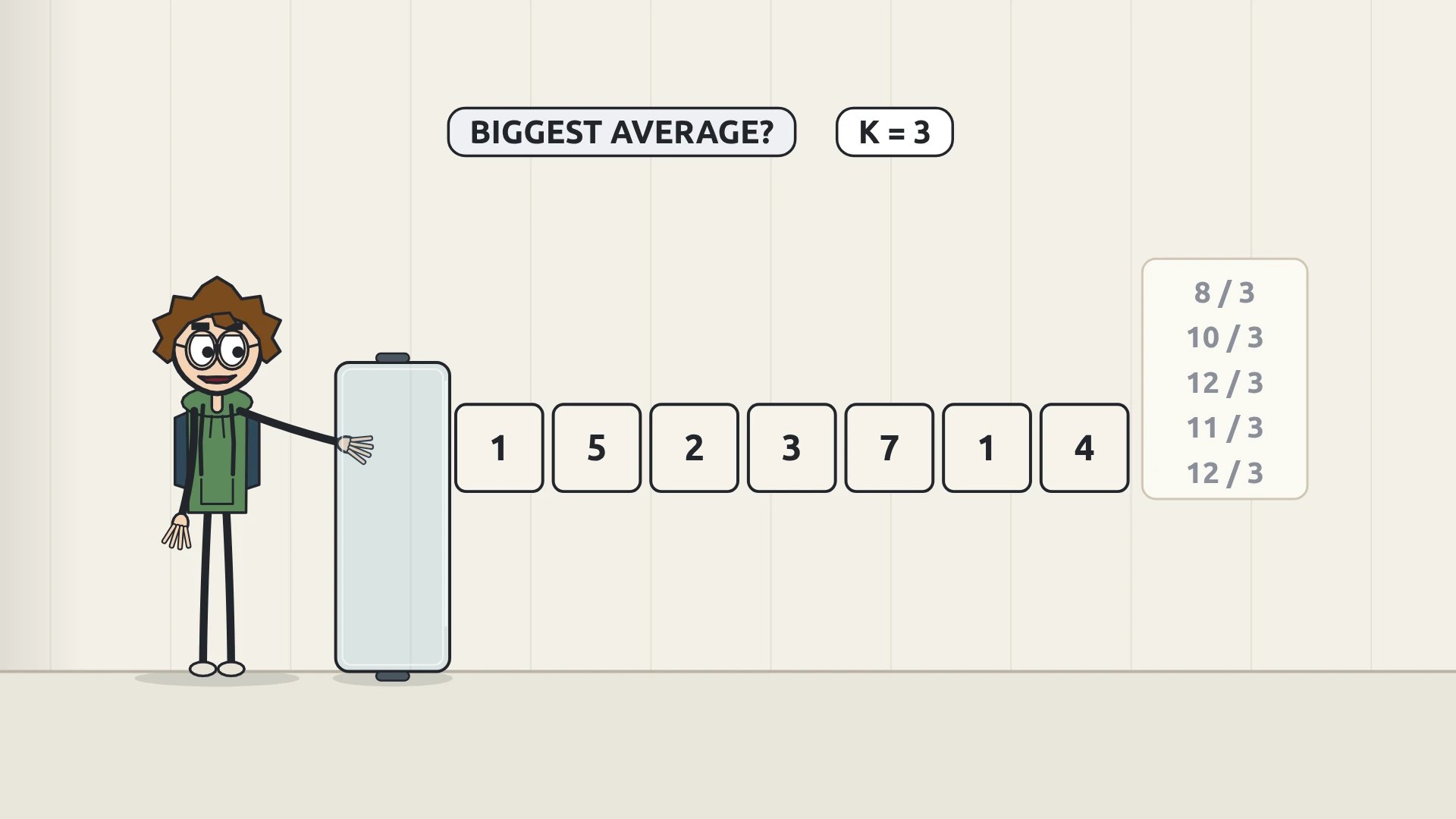
A row of numbers: 1, 5, 2, 3, 7, 1, 4. Which three numbers next to each other have the biggest average?
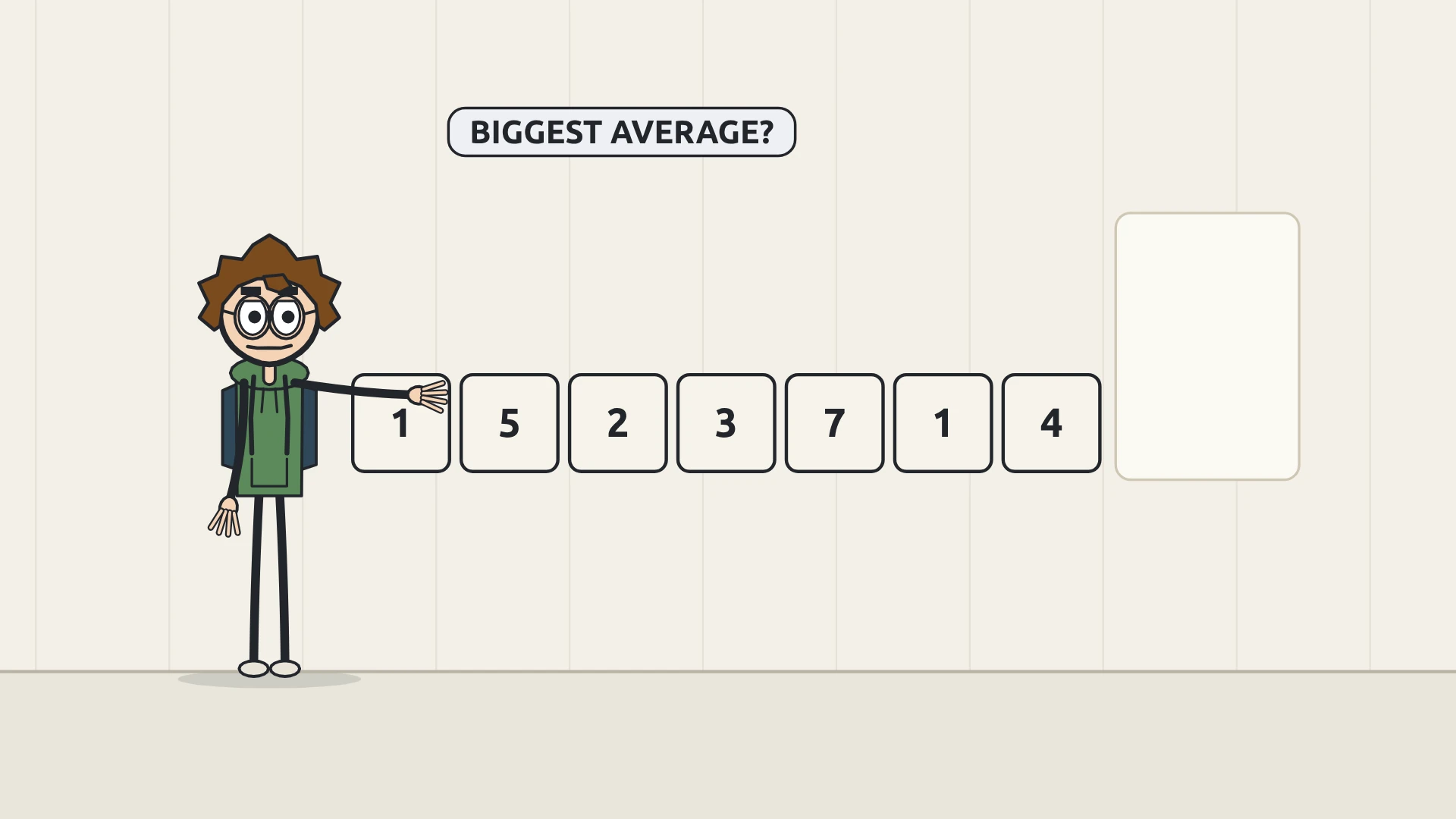
Stated in general: given a list of numbers and a size k, find the largest average of any k consecutive numbers. Every range has the same size, so the biggest average is simply the biggest sum, divided by k once at the end.
2 · The obvious ideaThe obvious way: add up every range
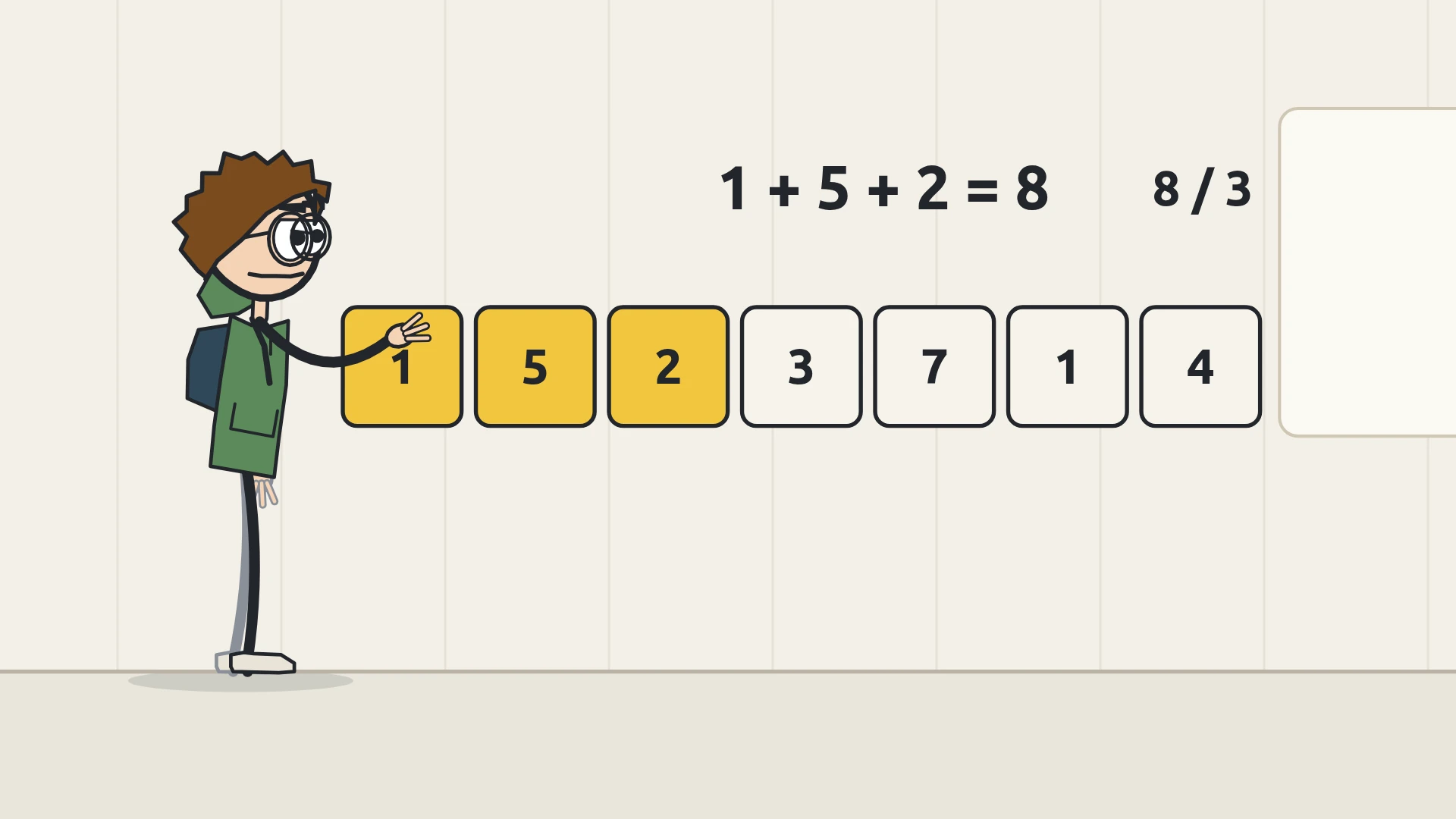
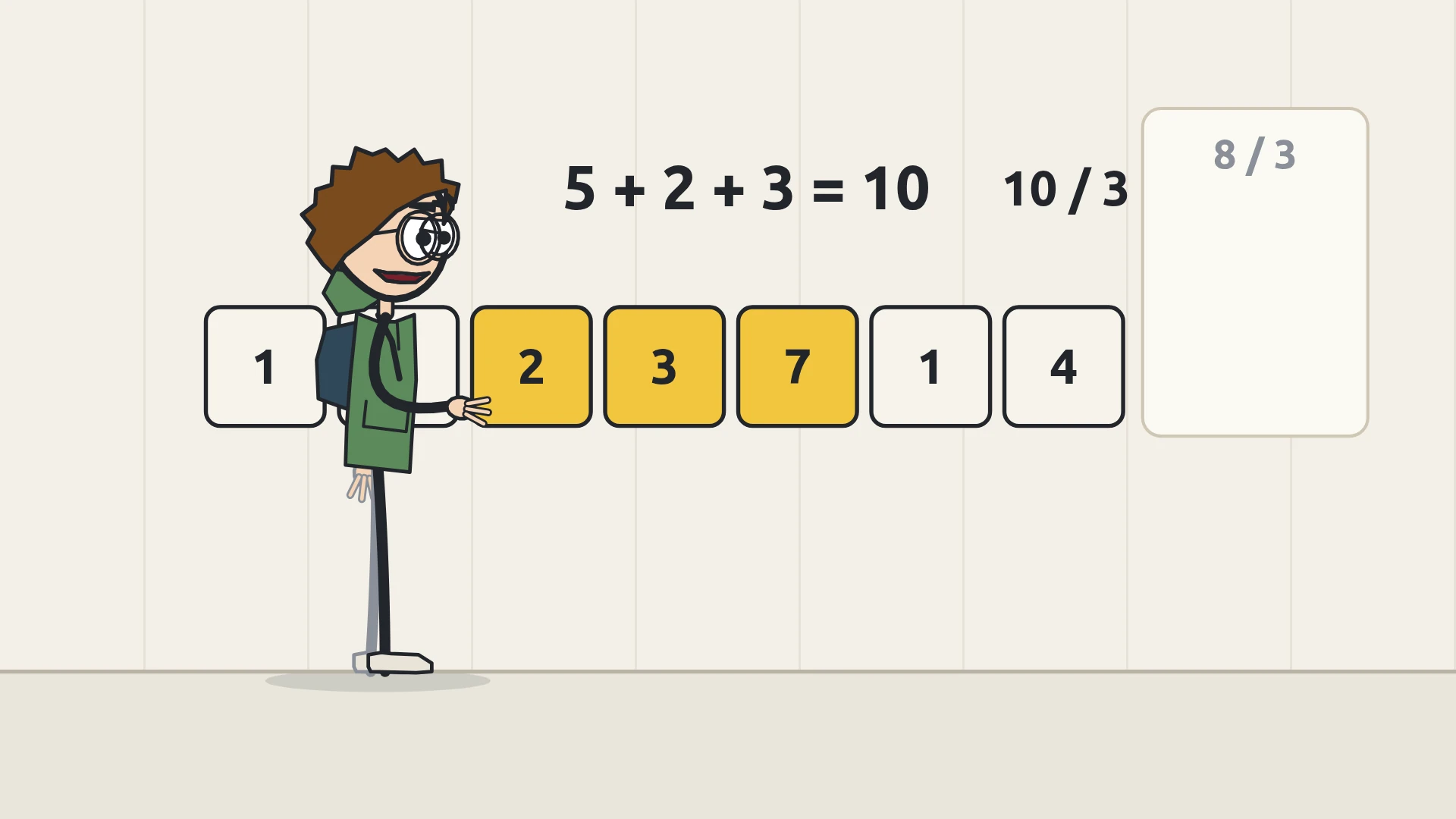
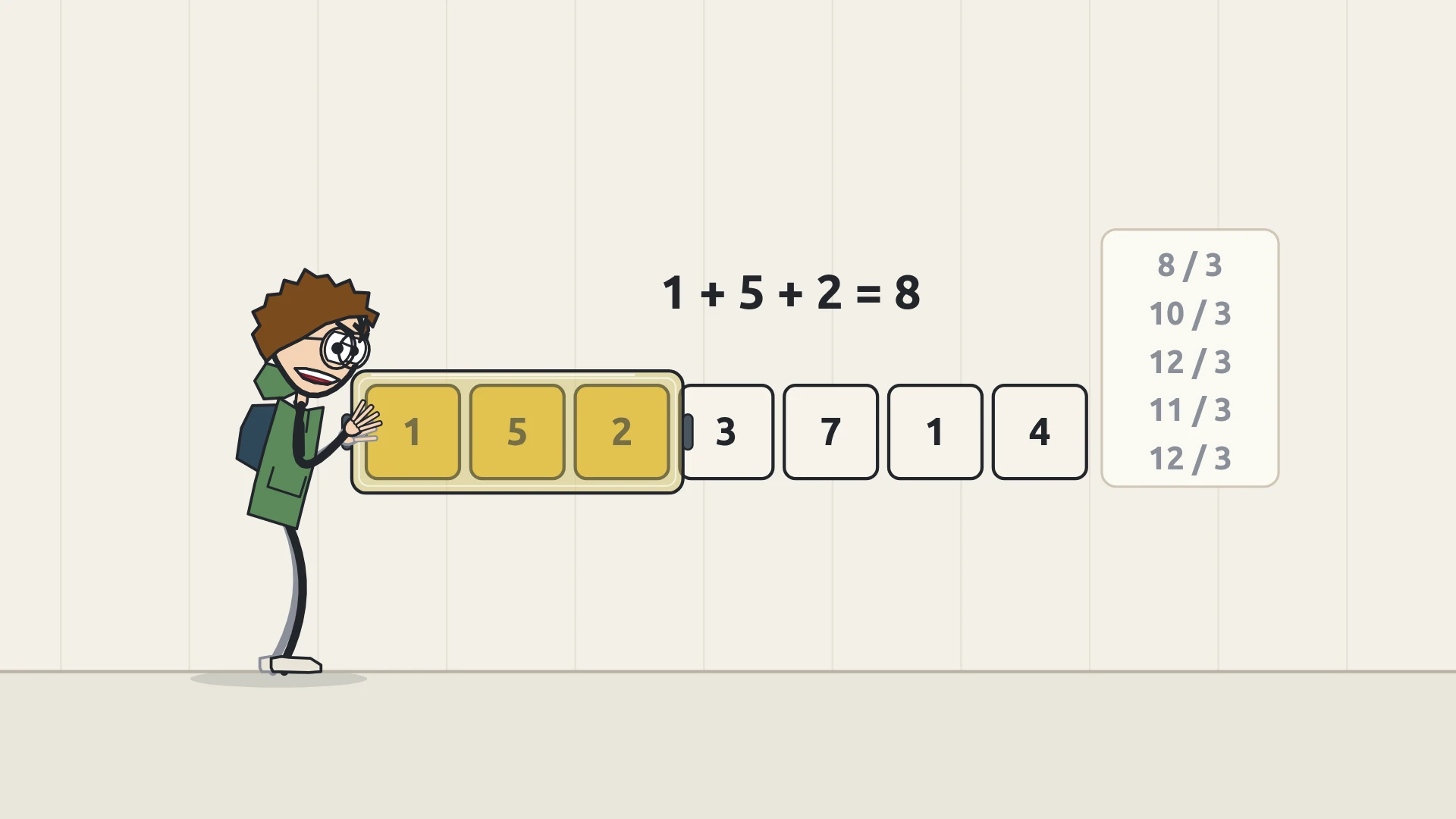
Easy. Take the first three: 1 + 5 + 2 = 8. Write down 8 / 3. Next three: 5 + 2 + 3 = 10. Next: 2 + 3 + 7 = 12. Then 3 + 7 + 1 = 11, and 7 + 1 + 4 = 12. The best is 12, an average of 4.
In code, a loop over every starting position with a loop inside it that adds up k numbers:
def max_average_every_window(nums, k): best = None for start in range(len(nums) - k + 1): total = 0 for j in range(start, start + k): total += nums[j] if best is None or total > best: best = total return best / kIt gives the right answer — 4.0 on this row. But the inner loop runs k times for every one of the n − k + 1 ranges.
3 · The observationDidn't I just calculate that?
Look at two neighbouring ranges: 5 + 2 + 3 and 2 + 3 + 7. The 2 and the 3 are in both. They didn't change — so why add them up again?
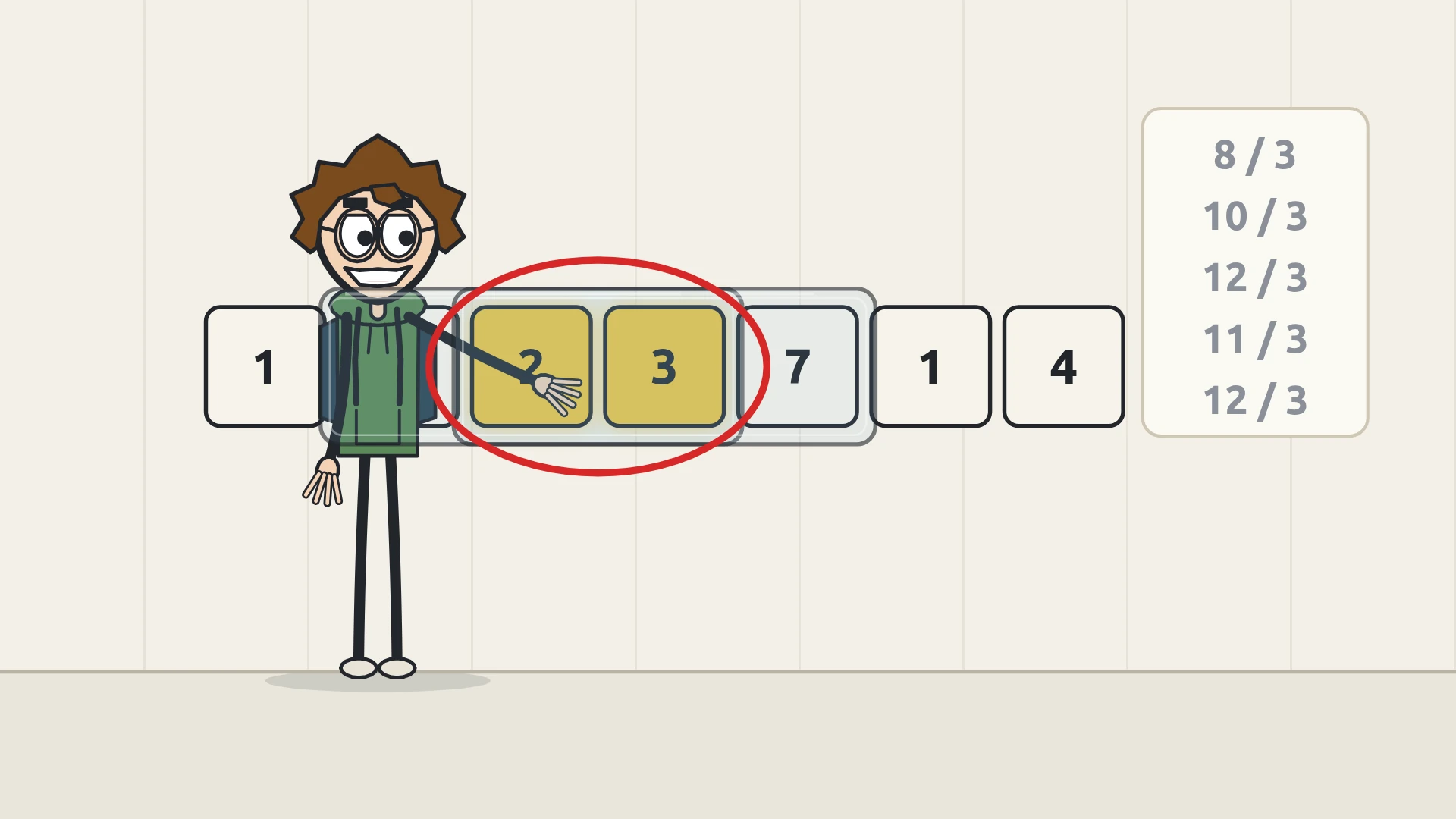
With ranges of three, two of the three numbers are always repeats. With ranges of a thousand, 999 of them are. Almost all of the work is work you already did.
4 · The discoveryA window over three numbers
So stop treating each range as a new problem. Keep one window the size of a range, and remember the sum of what is inside it.
5 · The moveOne leaves, one comes in
Push the window one step to the right. What actually changes? One number leaves on the left — the 1. One number comes in on the right — the 3. Everything else stays.
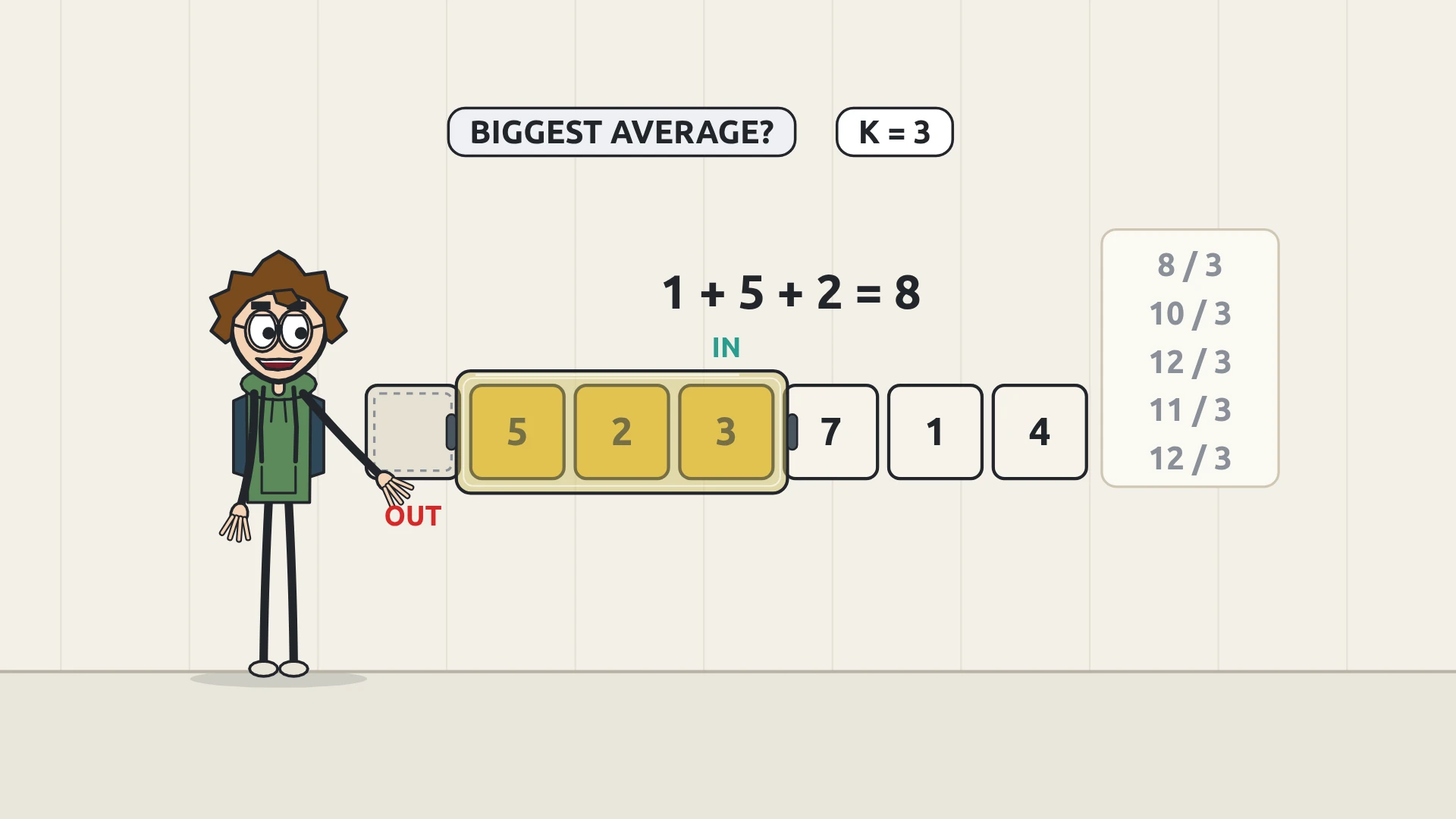
So the new sum doesn't need three additions. Take the old sum, subtract what left, add what came in: 8 − 1 + 3 = 10.
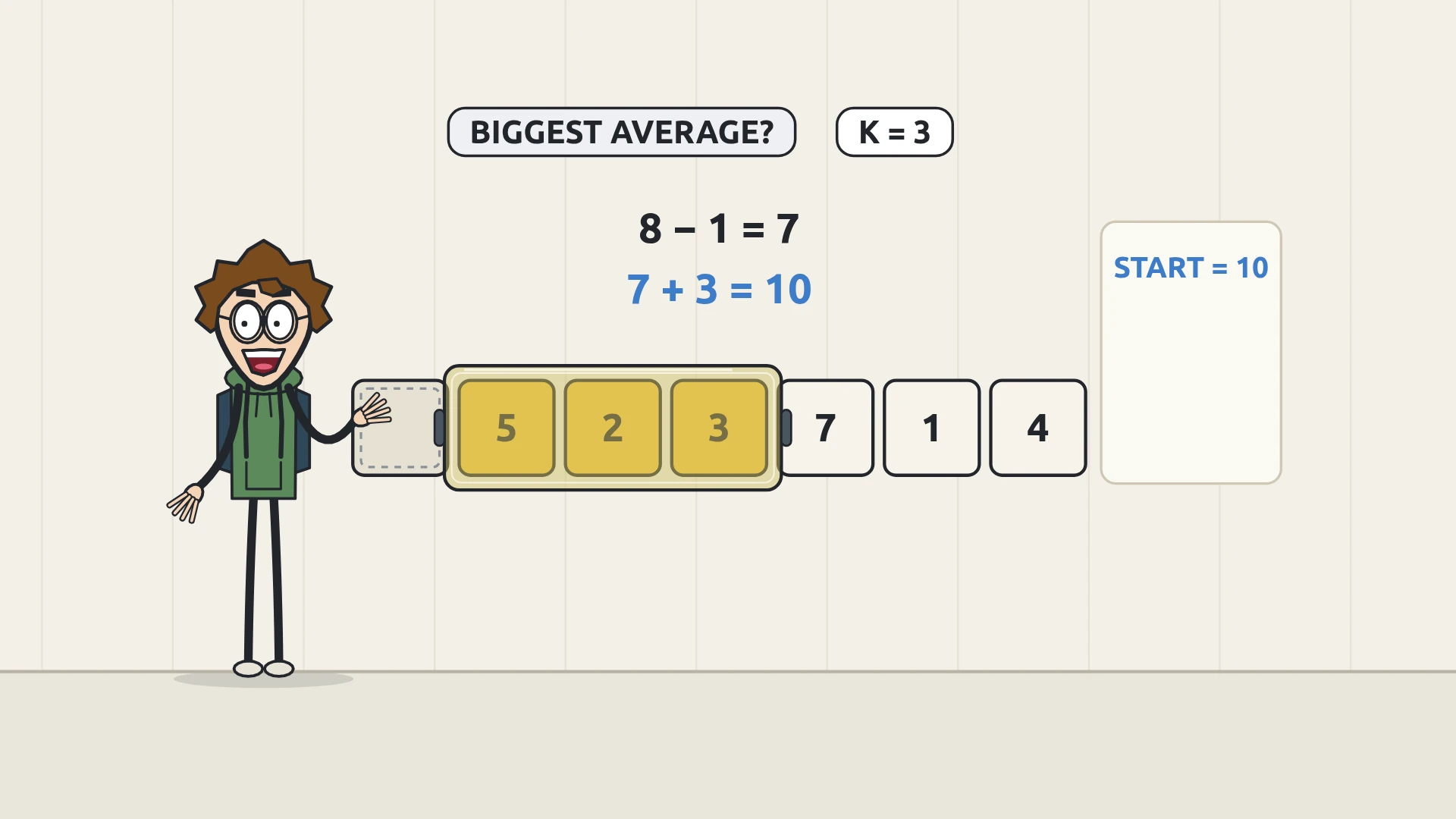
Keep pushing. Each step, the number that leaves is the one that was first in the window, and the one that enters is the next one on the right:
| Window | Leaves | Comes in | Sum | Best so far |
|---|---|---|---|---|
| 1 5 2 | — | — | 8 | 8 |
| 5 2 3 | 1 | 3 | 8 − 1 + 3 = 10 | 10 |
| 2 3 7 | 5 | 7 | 10 − 5 + 7 = 12 | 12 |
| 3 7 1 | 2 | 1 | 12 − 2 + 1 = 11 | 12 |
| 7 1 4 | 3 | 4 | 11 − 3 + 4 = 12 | 12 |
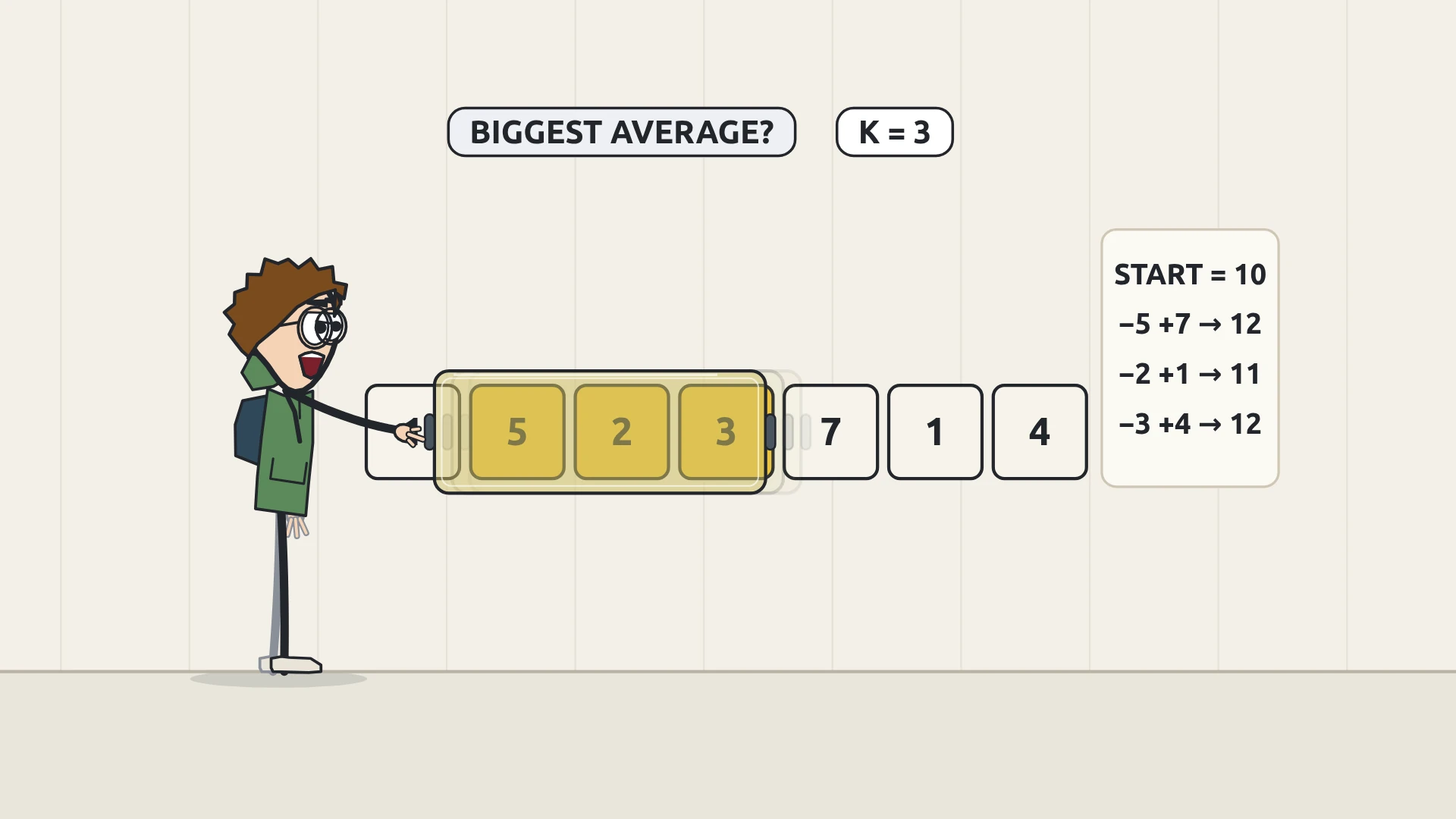
Best sum 12, best average 12 / 3 = 4. The same answer as before, with two operations per step instead of three — and with ranges of a thousand, two instead of a thousand.
6 · The nameThis is a sliding window
It just slides along the numbers. That's the name: a sliding window.
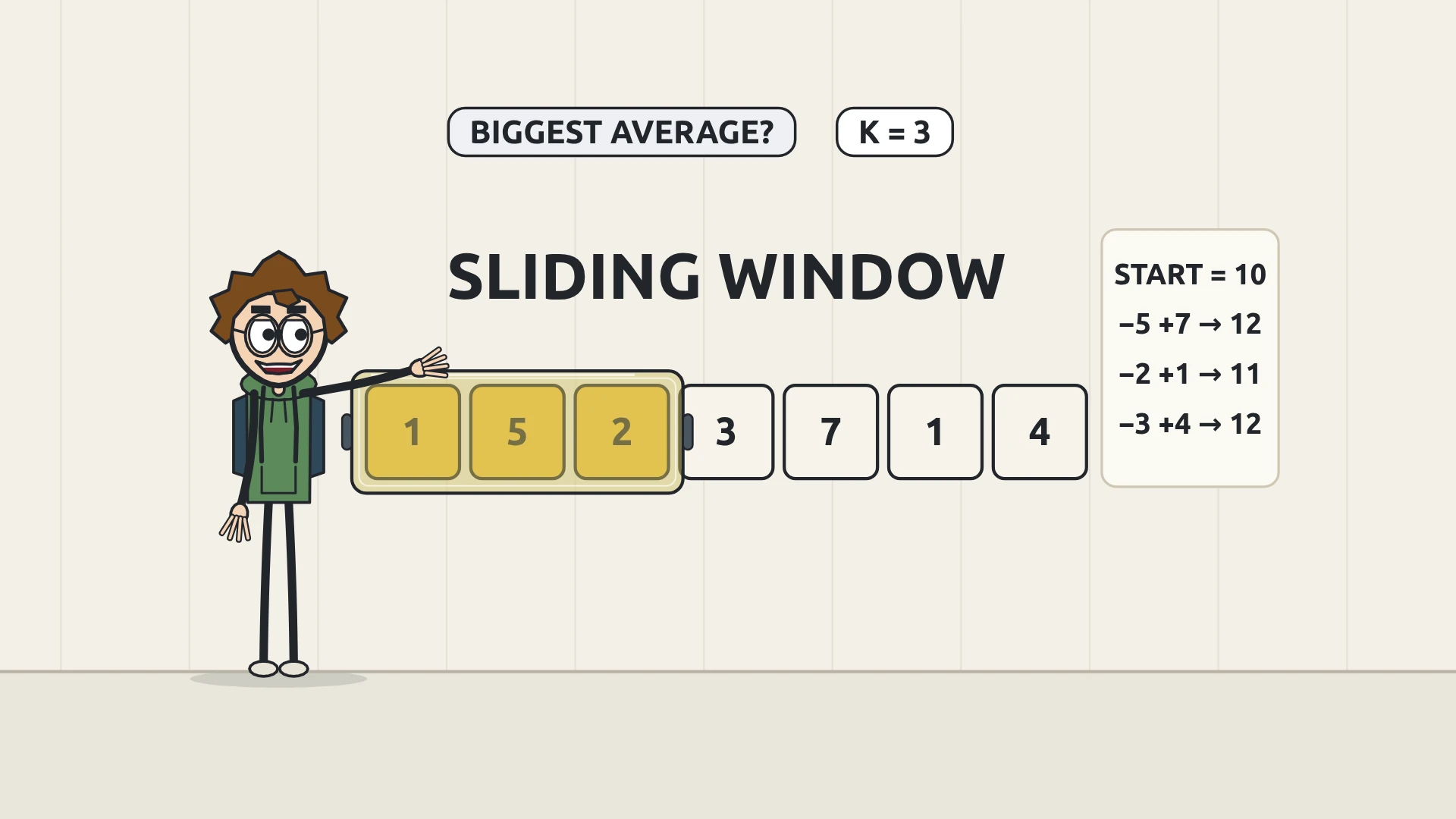
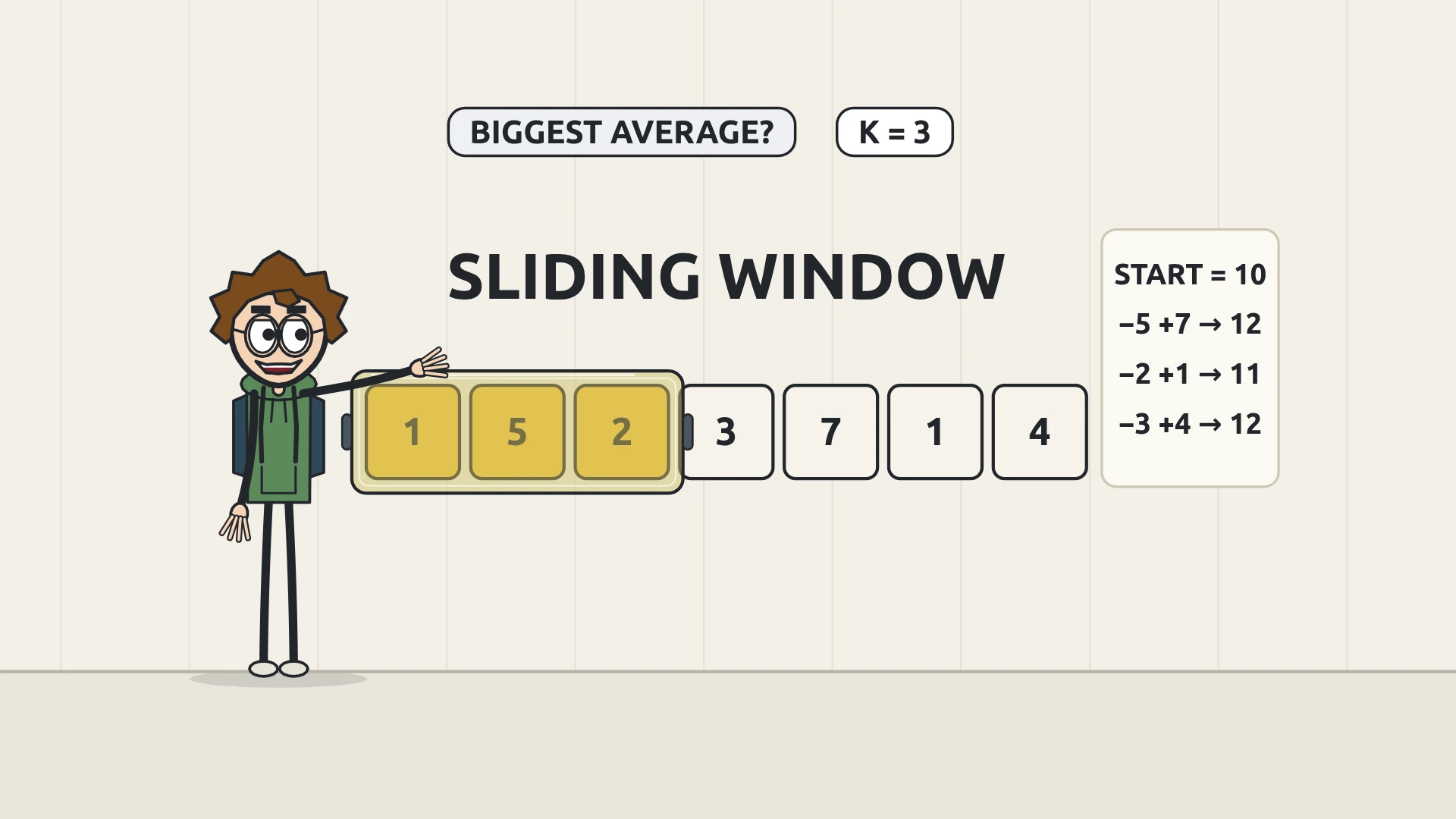
When you need to examine ranges of the same size, you don't start from zero every time. You keep the previous answer and update only what changed:
- Keep a window
Its size is fixed. Its sum is the one thing you remember.
- Remove what leaves
Subtract the number that falls out on the left.
- Add what enters
Add the number that comes in on the right.
- Update the result
Is this window the best so far?
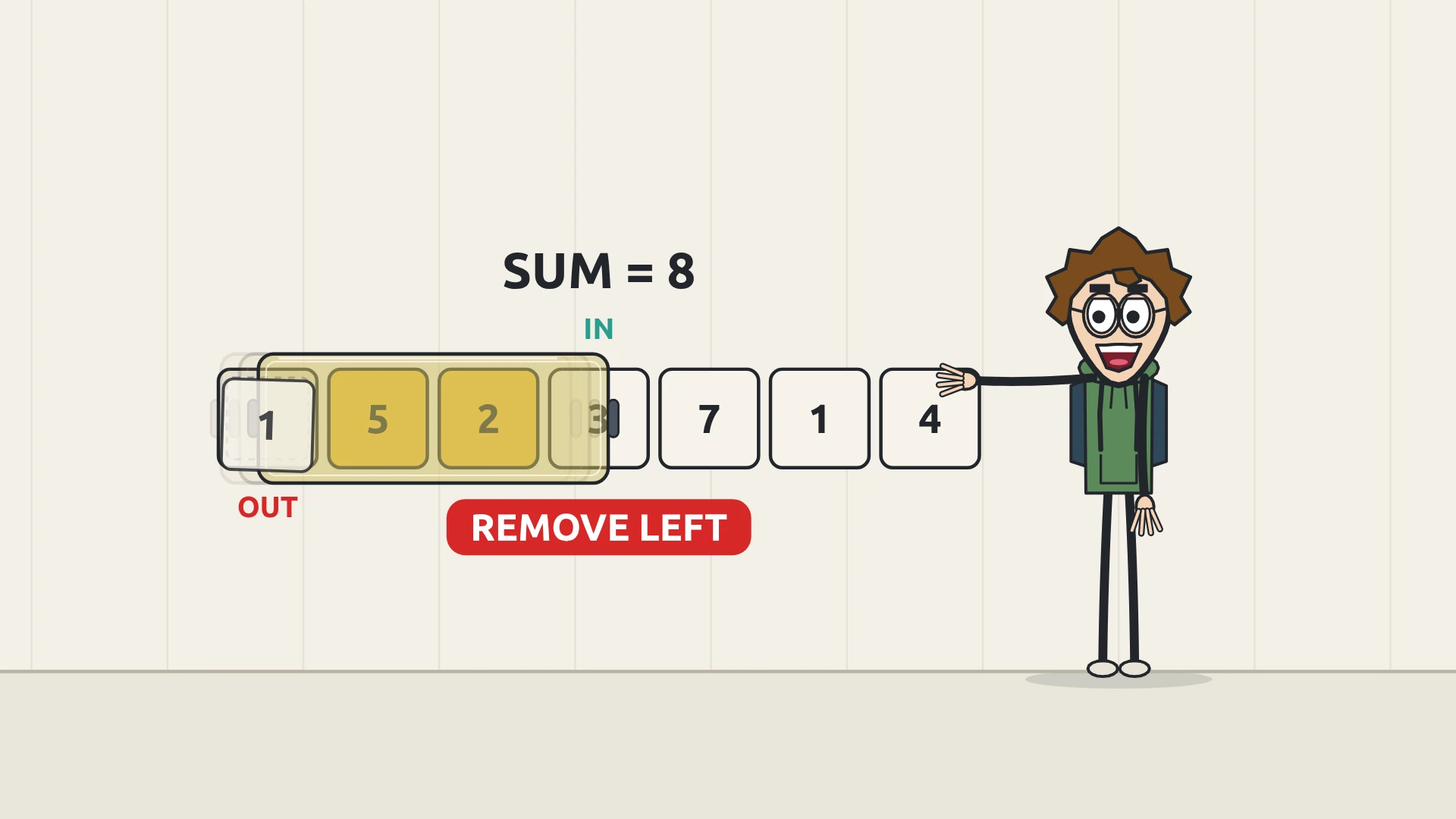
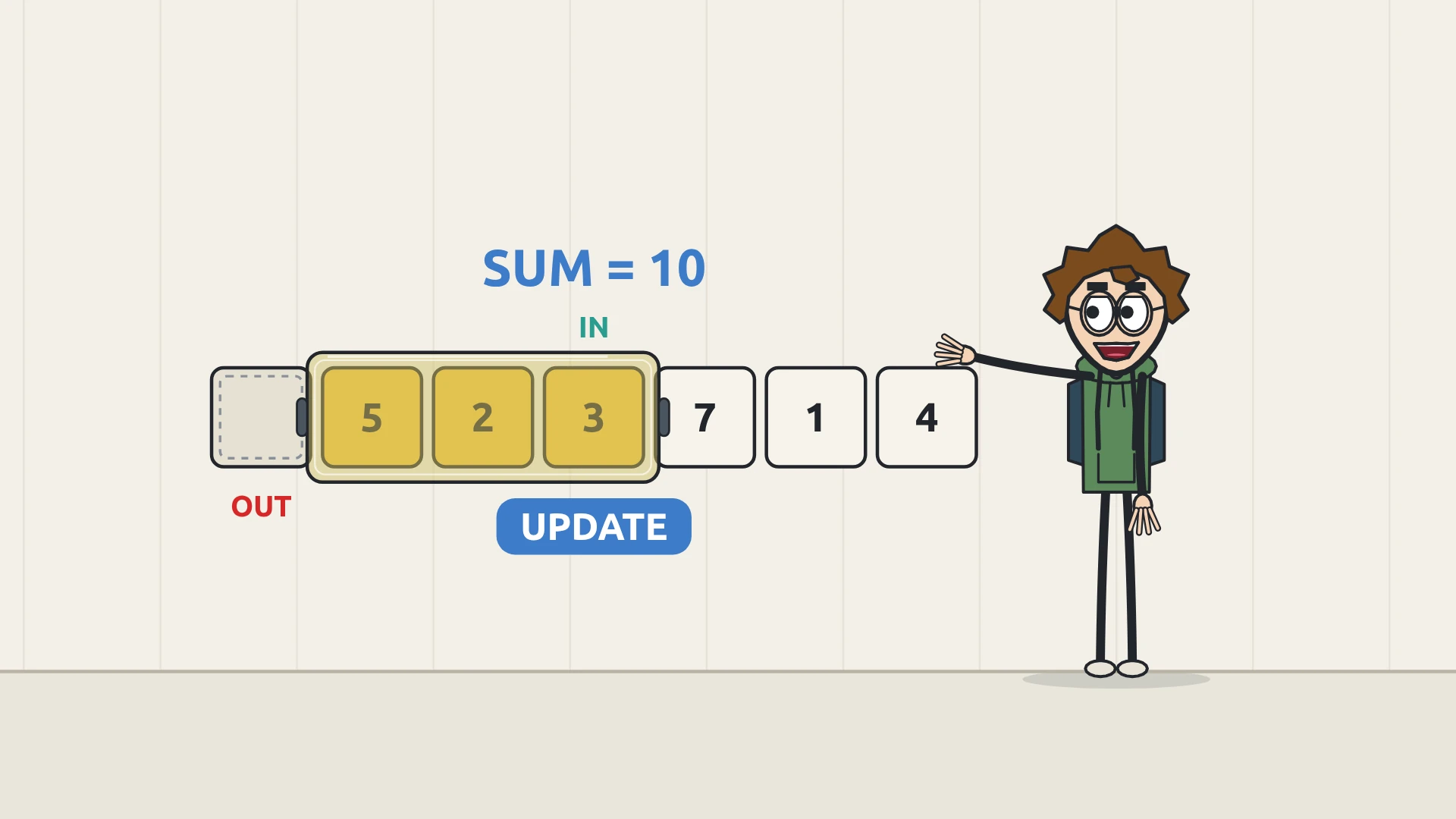
If most of the range stays the same, don't do the same work again. Find the part that changed — here one number on each side — and update the answer by that much.
7 · The costWhat it costs
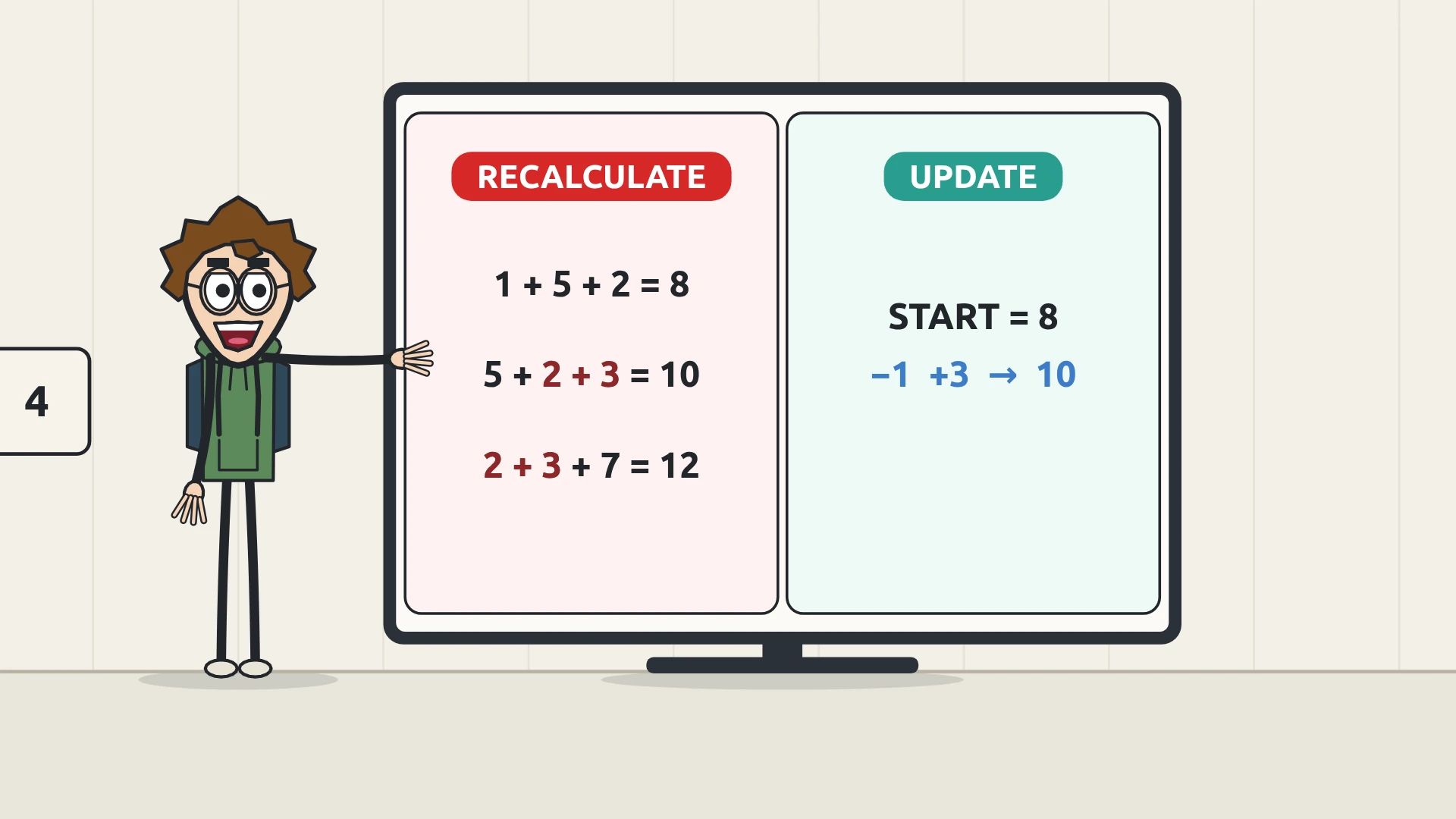
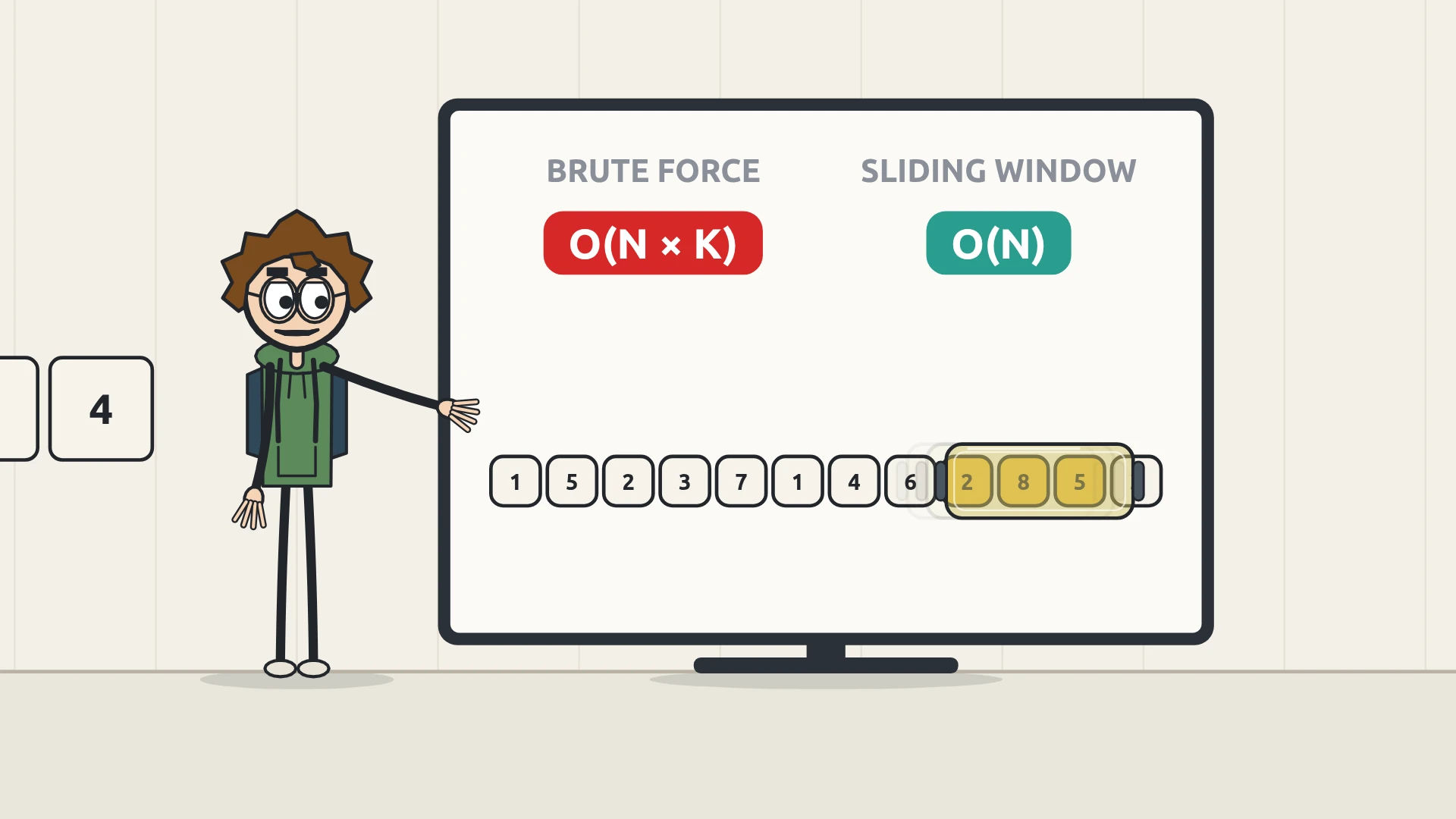
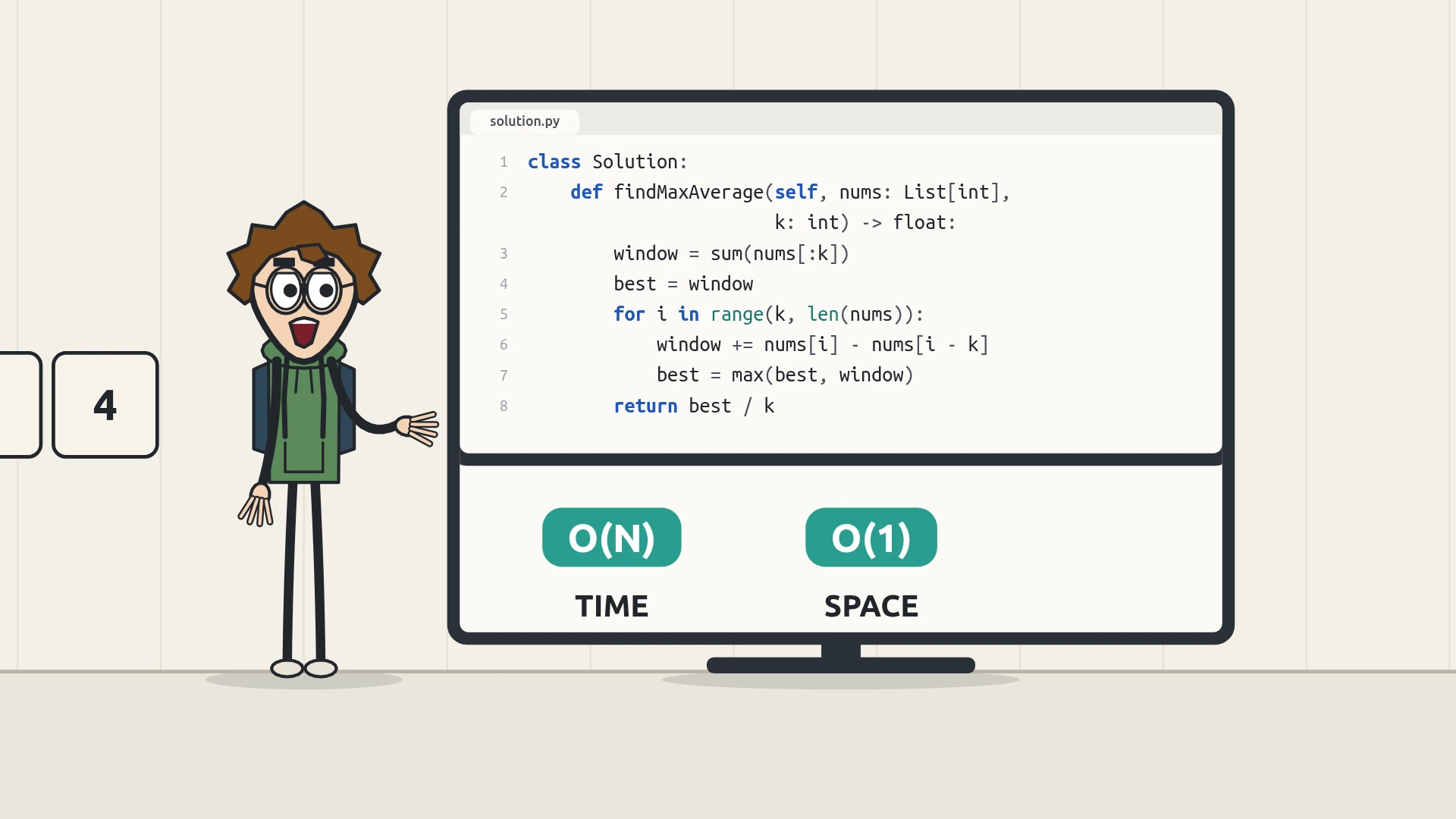
Recalculating does k additions for each of the n − k + 1 ranges: O(n · k). The window adds up the first k numbers once, then does one subtraction and one addition per step: O(n), whatever k is. It keeps two numbers, the window sum and the best: O(1) extra space.
8 · The codeThe code, one move per line
The function gets the numbers and k, the size of the window.
class Solution: def findMaxAverage(self, nums: List[int], k: int) -> float:The first window
Add up the first k numbers. That is the window's sum, and it is also the best so far.
class Solution: def findMaxAverage(self, nums: List[int], k: int) -> float: window = sum(nums[:k]) best = windowSlide
For every new number on the right — index i from k to the end — add it, and subtract the one that just left on the left. The one leaving is exactly k places behind the one entering: nums[i - k].
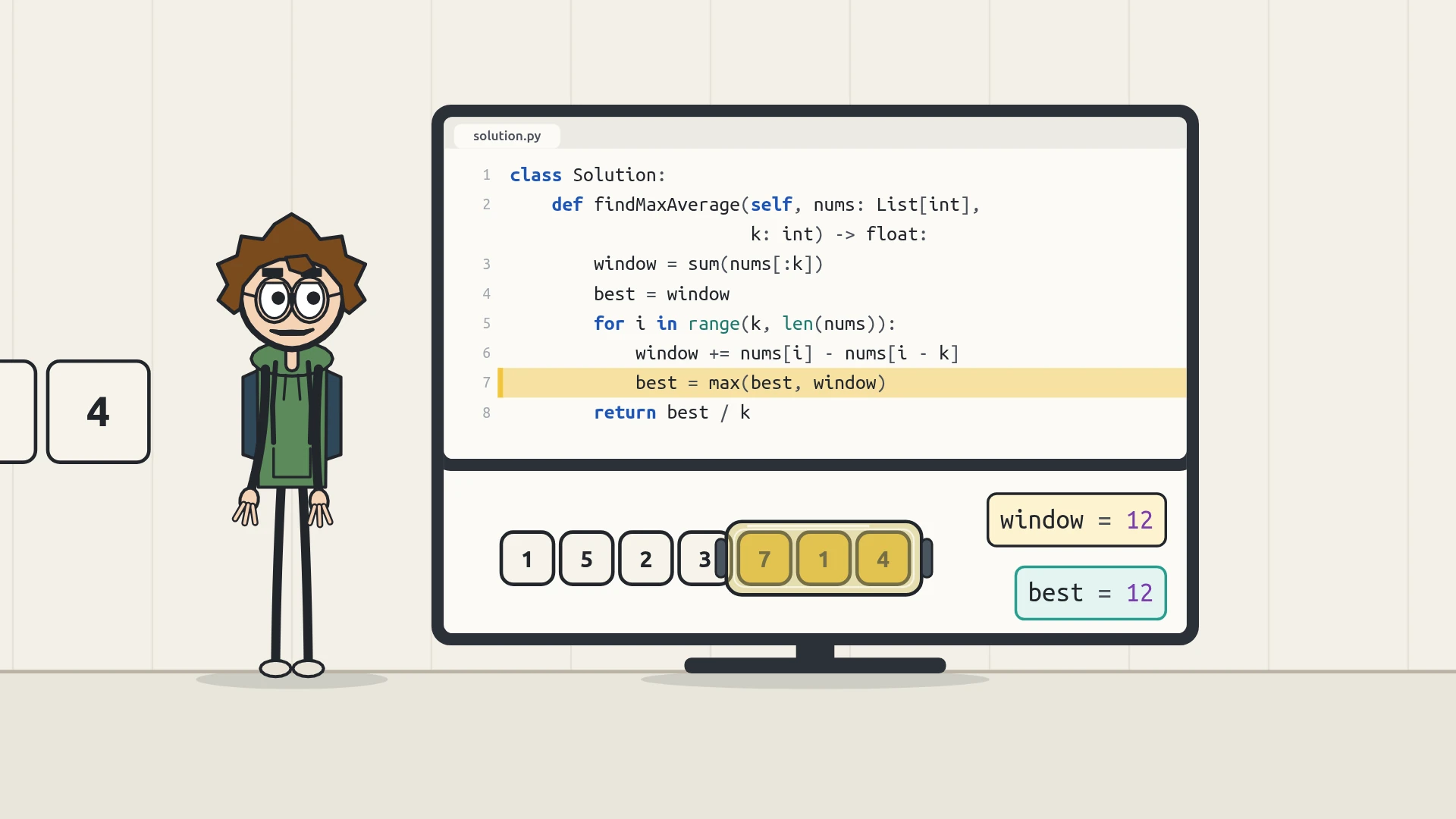
class Solution: def findMaxAverage(self, nums: List[int], k: int) -> float: window = sum(nums[:k]) best = window for i in range(k, len(nums)): window += nums[i] - nums[i - k]One add, one subtract. Not k additions.
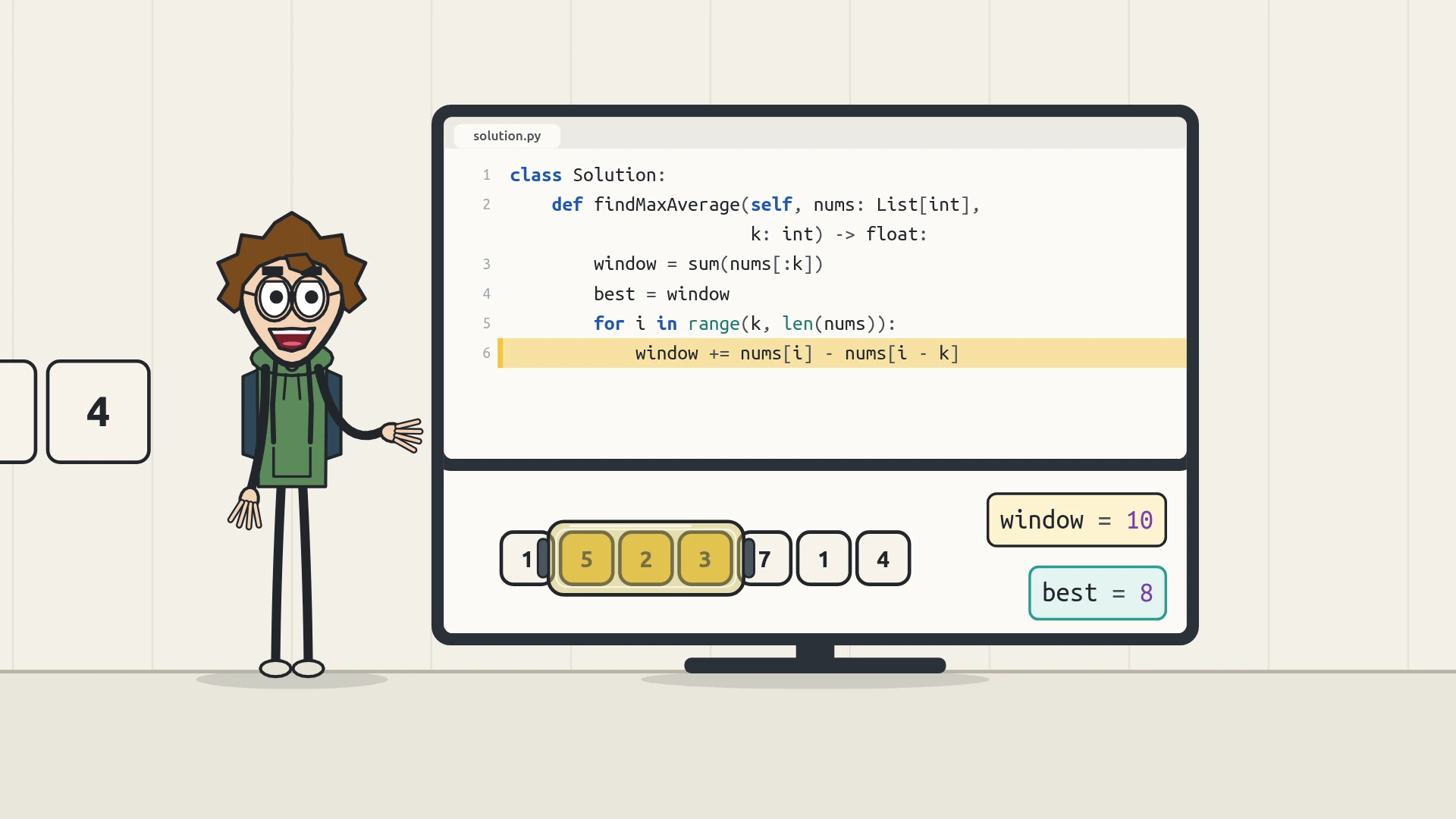
Keep the best
for i in range(k, len(nums)): window += nums[i] - nums[i - k] best = max(best, window)Divide once
At the end, divide the best sum by k. Just once — comparing sums is the same as comparing averages when every window has the same size.
class Solution: def findMaxAverage(self, nums: List[int], k: int) -> float: window = sum(nums[:k]) best = window for i in range(k, len(nums)): window += nums[i] - nums[i - k] best = max(best, window) return best / kThe whole thing
class Solution: def findMaxAverage(self, nums: List[int], k: int) -> float: window = sum(nums[:k]) best = window for i in range(k, len(nums)): window += nums[i] - nums[i - k] best = max(best, window) return best / kRun it on the row: the window sums are 8, 10, 12, 11, 12; the best is 12; 12 / 3 = 4.0. On a second example, [1, 12, -5, -6, 50, 3] with k = 4, it returns 12.75: the best window is 12, −5, −6, 50, whose sum is 51, and 51 / 4 = 12.75.
The signature uses the type hint List[int], as the editor in the video does. In a plain Python file, put from typing import List at the top first (or write list[int] on Python 3.9 and later).
9 · The trapThe off-by-one to avoid
The usual mistake is in the one line that matters: the number leaving is nums[i - k]. Write nums[i - k + 1] instead and you subtract a number that is still inside the window, while the one that really left stays in the sum.
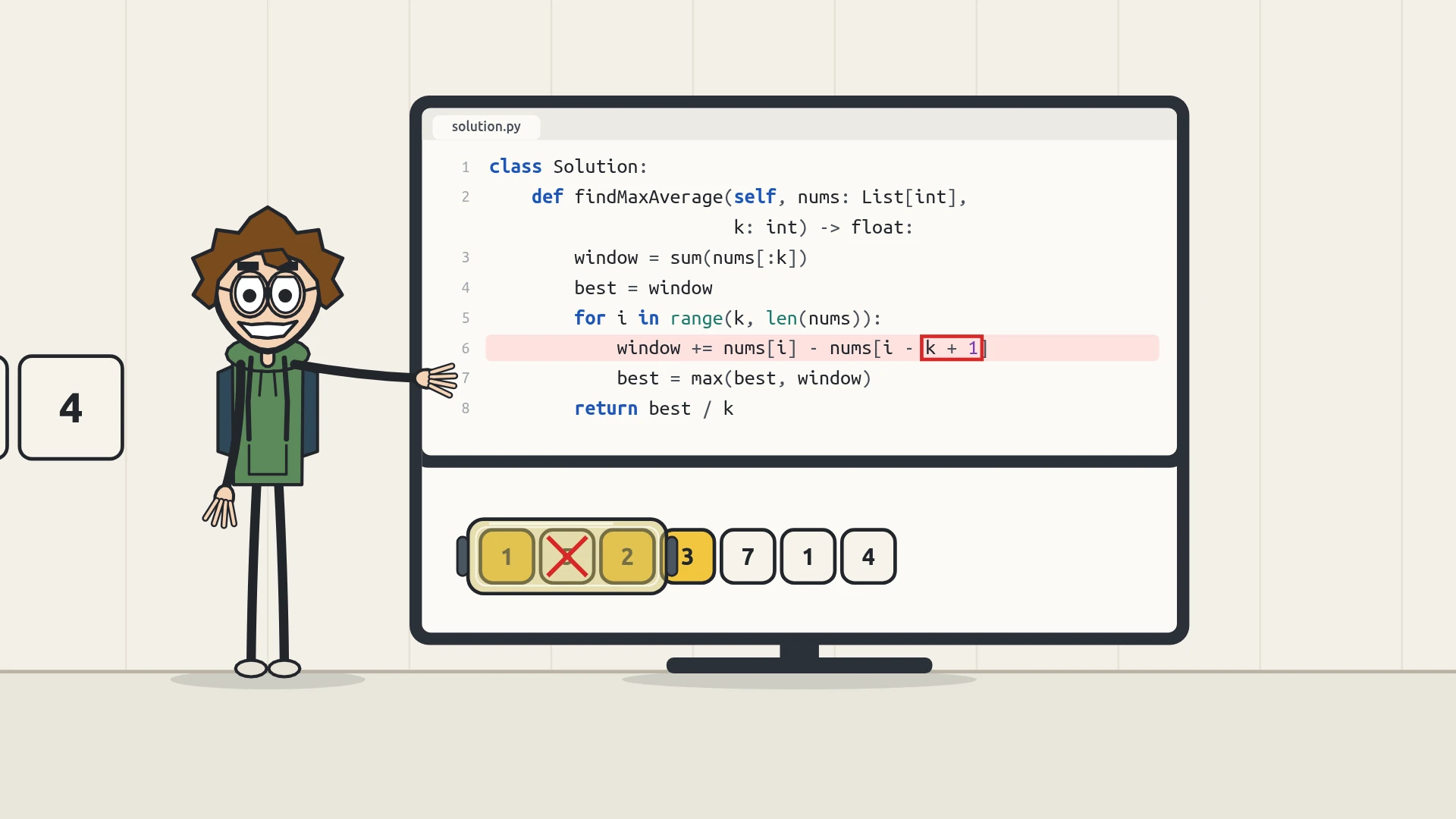
On our row the buggy version's sums go 8, 6, 11, 9, 6 — it reports 11 / 3 ≈ 3.67 instead of 4. Nothing crashes, which is what makes it dangerous. Check the index with one concrete step: when i = 3 (the 3 enters), the leaving number must be index 0 (the 1): 3 − 3 = 0.
10 · Try itSlide your own window
The window, step by step
The Python above, translated to run in your browser. Change the numbers and k, step through the slide, and compare how many numbers it reads with recalculating every range. Switch the bug on to watch the off-by-one go wrong.
11 · The lessonHow to recognize it
The problem never says "sliding window". What it says is: every range of k consecutive items, or the best / longest / shortest stretch that…. Two questions give it away:
- Am I looking at contiguous ranges?
Neighbouring items, in order — not any subset.
- Do neighbouring ranges overlap?
If the next range is the last one minus one item plus one item, you can update instead of recompute.
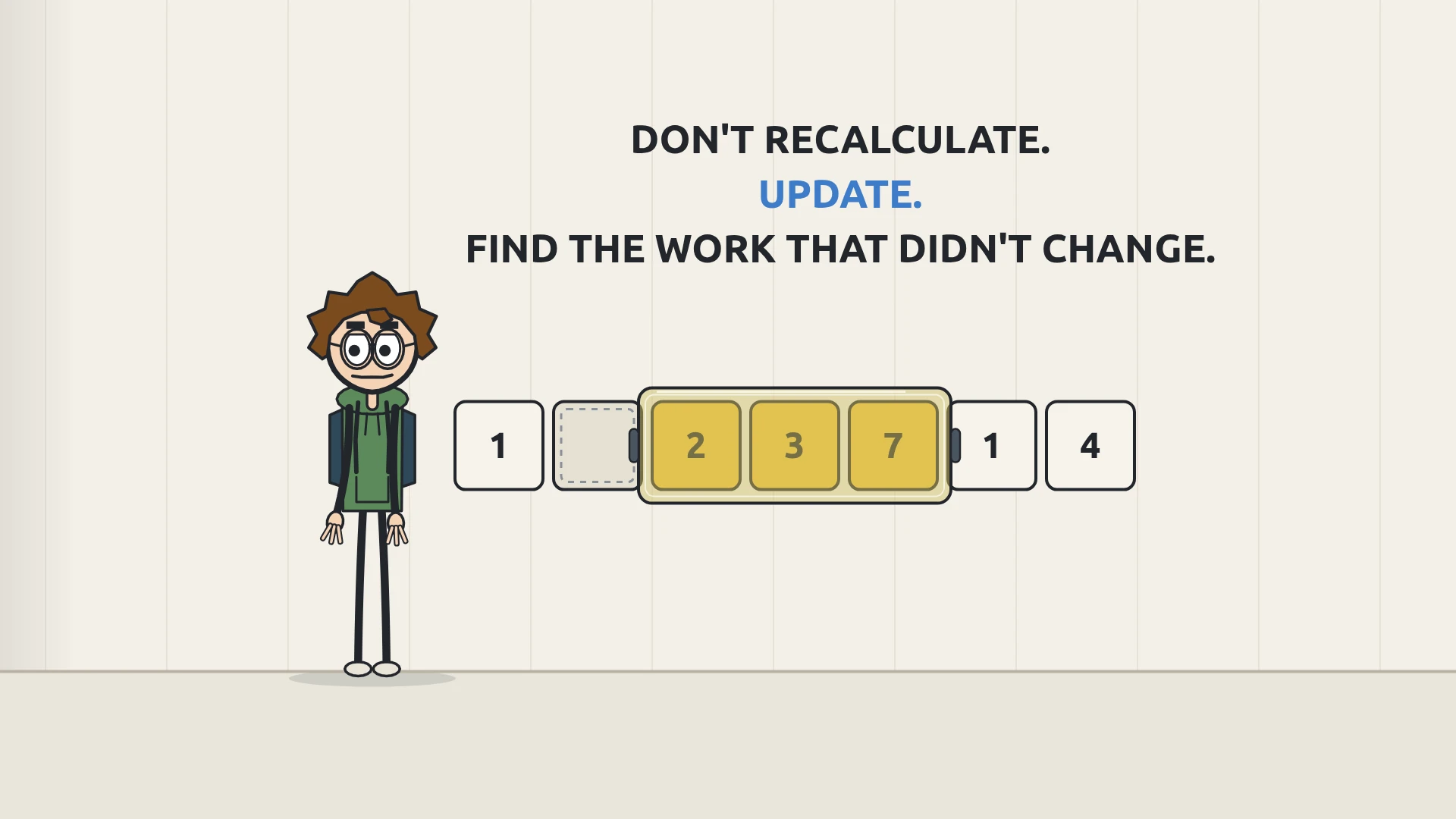
Here the window has a fixed size. In many problems it doesn't: it grows on the right until a rule breaks, then shrinks from the left until the rule holds again. Same two moves — something enters, something leaves — just not in lockstep.
12 · PracticeFour problems, same shape
Don't watch the solution. For each one, decide what the window holds, what you update when a number enters, and what you undo when one leaves.
- Warm-upMaximum average of k in a row, from scratch
Close this page and write it. Then count your additions on a list of 100,000 numbers with k = 1,000, and compare with the every-range version.
- PracticeRanges of size k with an average over a threshold
Count how many windows of size k have an average at least some threshold. The window is the same; what changes is what you do with each sum.
- VariationThe most vowels in a substring of length k
A string instead of numbers. What does the window keep now — and what is "one leaves, one comes in" for letters?
- ChallengeIs an anagram of one word hidden in another?
Does some window of the second word use exactly the letters of the first? The window keeps letter counts; the hard part is checking them fast at each step.
A close cousin — two pointers →
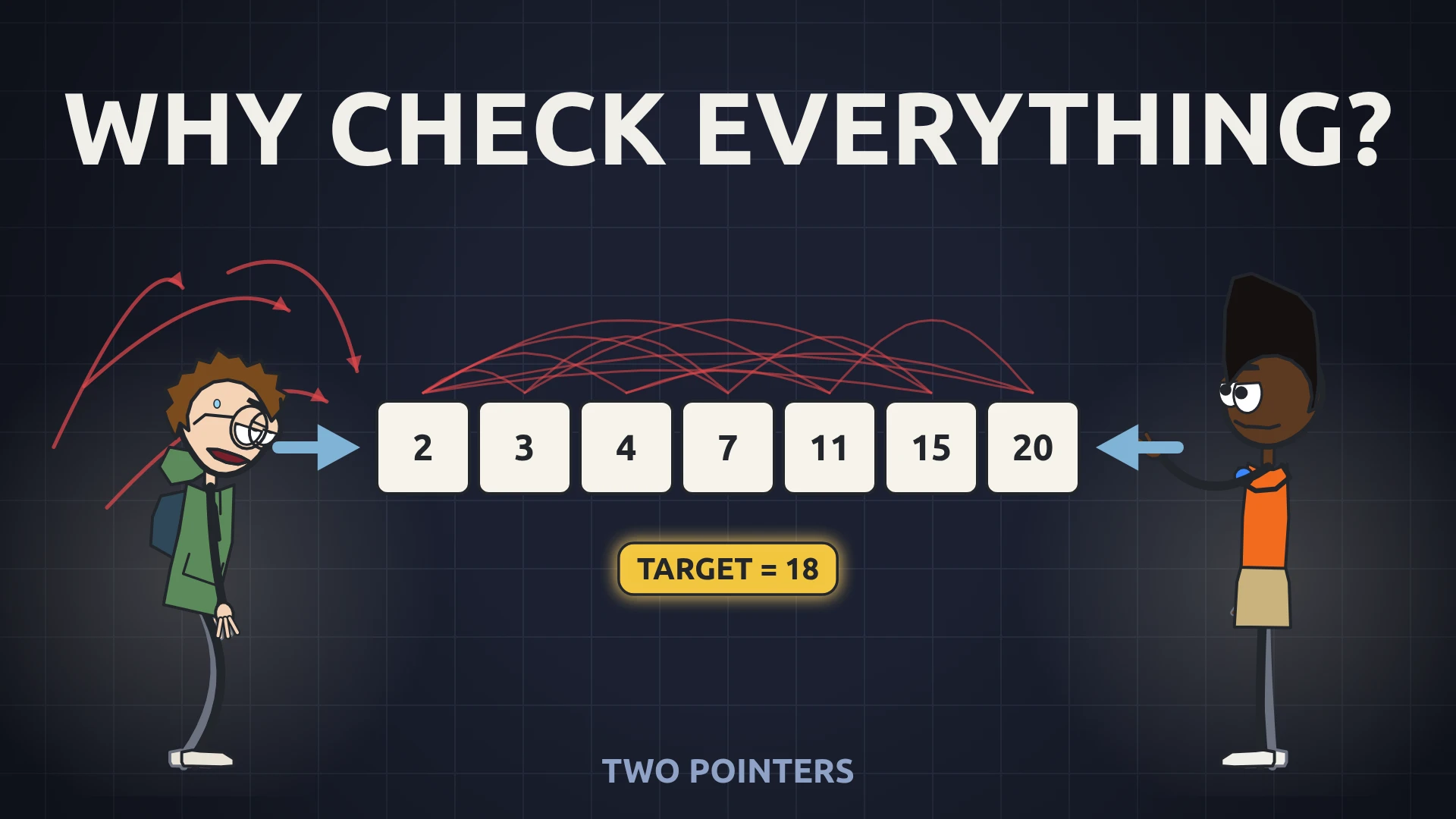
A window is two positions moving the same way. Two pointers moving toward each other solve a different question: two prices on a sorted shelf that add up to exactly $18, in three checks.
If most of the range stays the same, don't do the same work again.